

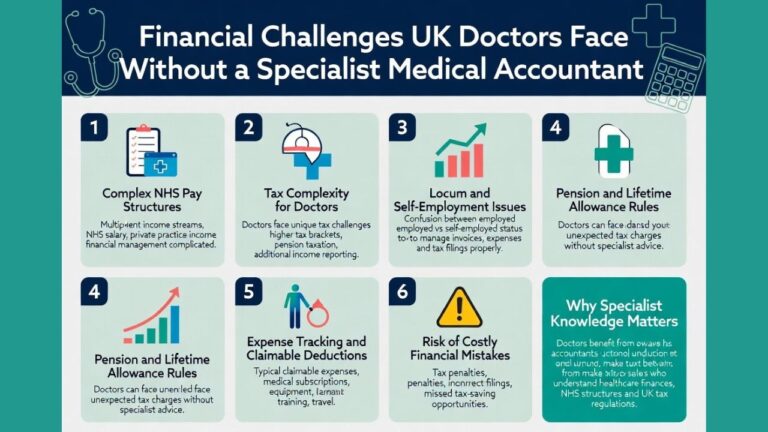
For most professionals, “doing the taxes” involves a single P60 and perhaps a few bank interest statements. For a UK doctor, it is rarely that simple. Between NHS contracts, locum shifts, private practice, and the labyrinthine rules of the NHS pension scheme, medical professionals face a financial reality that is uniquely taxing literally.
In this guide, we dive deep into the world of accounting for doctors, exploring why standard accounting isn’t enough for the medical community and how proactive financial management can save you thousands.
Introduction:
Why Accounting for Doctors Is More Complex Than Other Professions
Doctors don’t just have jobs; they have “career portfolios.” A consultant might be an employee of an NHS Trust, a sole trader for private clinics, and a limited company director for locum work all in the same week.
Why is medical accounting different?
The primary reason is the fragmented nature of income. Most accountants are used to “linear” careers. Doctors, however, operate in a circular economy of public and private work. Each income stream has different tax treatments, National Insurance implications, and reporting requirements.
Do NHS doctors really need accountants?
Many junior doctors assume that because they are on PAYE, HMRC handles everything. This is a costly misconception. The frequency of rotation between trusts often leads to emergency tax codes, and the failure to claim back professional expenses means many doctors are effectively giving the government a “voluntary donation” every year.
The Biggest Financial Challenges UK Doctors Face
The UK tax system has several “cliffs” and “traps” that seem almost specifically designed to catch high-earning medical professionals.
1. Managing Multiple Income Streams
If you earn from an NHS salary, locum shifts, and consulting, HMRC’s systems often struggle to keep up.
- The Risk: Each employer might apply a standard tax code, leading to an underpayment of tax that results in a massive, unexpected bill at the end of the year.
- The Solution: Proper accounting for doctors involves “tax code smoothing,” ensuring your personal allowance is allocated correctly across your different roles.
2. NHS Pension Tax Complications
The NHS pension is one of the best in the world, but it is also a tax minefield.
- Annual Allowance (AA): There is a limit on how much your pension can grow each year before you are taxed. Because doctors often receive significant pay jumps (e.g., moving from Registrar to Consultant), “pension growth” can exceed this limit easily.
- The Tapered Annual Allowance: For high earners, the £60,000 allowance can be “tapered” down to as little as £10,000, leading to tax charges that sometimes exceed the actual cash take-home pay of an extra shift.
3. Incorrect Tax Codes
Doctors move hospitals frequently. When you move from Trust A to Trust B, it is common for HMRC to think you hold two full-time jobs, resulting in “BR” (Basic Rate) or “D0” (Higher Rate) codes being applied to your entire salary. Without a specialist eye, these errors can go unnoticed for years.
4. The £100k Tax Trap
This is the most “painful” zone in UK taxation. Once you earn over £100,000, you lose £1 of your Personal Allowance for every £2 earned.
- The Result: Between £100,000 and £125,140, your effective tax rate is 60%. When you add National Insurance and pension contributions, some doctors take home less than 30p for every extra £1 they earn in this bracket.
Tax Obligations Doctors Often Misunderstand
Compliance is not just about paying tax; it’s about reporting it correctly to avoid penalties.
Self-Assessment Requirements
You must register for Self-Assessment if:
- Your income exceeds £150,000 (even if all on PAYE).
- You have untaxed income over £2,500 (e.g., private practice or locum work).
- You are a GP Partner (who are technically self-employed).
Locum Doctor Tax Rules: IR35
The “Off-Payroll Working” rules (IR35) have changed the landscape for locums. Many NHS roles are now “Inside IR35,” meaning you are taxed like an employee even if you work through a limited company. Operating a limited company when you are “Inside IR35” adds layers of administrative cost with few tax benefits. A specialist accountant can help you decide if a Limited Company or an Umbrella company is more efficient for your specific contract.
Tax Deductions Doctors Frequently Miss
One of the biggest benefits of professional accounting for doctors is the “found money” discovered through allowable expenses. If you pay for these out of your own pocket and they are “wholly, exclusively, and necessarily” for your job, you can claim tax relief.
Commonly missed deductions include:
- Professional Fees: GMC, BMA, Royal College memberships, and MDU/MPS indemnity insurance.
- Medical Equipment: Stethoscopes, surgical loupes, and even specialized software.
- Training and Exams: Mandatory CPD courses and Royal College exam fees (often overlooked by junior doctors).
- Travel: While you cannot claim for your commute to a permanent base, travel between hospitals or to different sites for locum shifts is often claimable.
Pro Tip: You can often backdate these claims for up to four years. If you haven’t been claiming your GMC fees, you could be owed a significant rebate.
Costly Financial Mistakes Doctors Commonly Make
We see the same patterns of financial loss across the medical profession. Most are due to “DIY” accounting or using a generalist accountant who doesn’t understand the NHS structure.
- Ignoring the Pension Savings Statement: Many doctors bin these, not realizing they contain the data needed to calculate a potential tax charge.
- Missing the Self-Assessment Deadline: HMRC penalties start at £100 and scale rapidly.
- Poor Income Structuring: Working extra locum shifts without realizing they are pushing you into the 60% tax trap.
- Inaccurate Records: Not keeping receipts for professional expenses, meaning you can’t prove your deductions if HMRC audits you.
How a Specialist Medical Accountant Helps Doctors
A specialist accountant, like the team at Lanop Business & Tax Advisors, acts as a financial shield.
- Pension Tax Guidance: We don’t just “do the math”; we help you understand if you should “Scheme Pay” (have the pension pay your tax bill) or pay it upfront.
- Expense Optimisation: We ensure every single allowable pound is deducted from your taxable income.
- Financial Strategy: We help you decide when to work. If a weekend locum shift is going to cost you more in pension tax than you earn, we tell you.
- Compliance Management: We handle the HMRC correspondence so you can focus on your patients.
When Should a Doctor Hire an Accountant?
While a medical student doesn’t need an accountant, there are “trigger points” where professional help becomes essential:
- Promotion to Consultant or GP Partner: The jump in complexity is massive.
- Starting Private Practice: You are now a business owner.
- Crossing the £100k Threshold: You need a strategy to mitigate the 60% tax trap.
- Receiving a Pension Tax “Brown Envelope”: If the NHS Pension Agency sends you a statement about exceeding the Annual Allowance, seek help immediately.
How to Choose the Right Accountant for Doctors
Don’t just hire the person who does your neighbor’s small business accounts. You need a specialist who understands:
- The difference between a Clinical Impact Award and a standard bonus.
- How HMRC’s “Standardised Life” rules apply to medical training.
- The intricacies of the NHS Pension Scheme (1995, 2008, and 2015 versions).
Why Lanop Business & Tax Advisors?
At Lanop, we specialize in the healthcare sector. We provide fixed-price packages so you never have to worry about a “ticking clock” when you call us for advice. Our goal is to ensure your financial health is as robust as the care you provide your patients.
Real Financial Scenarios Doctors Face
Scenario 1: The High-Earning Junior Doctor
- The Situation: Dr. A earns £75k in her ST5 role and does £30k of locum work.
- The Problem: Her total income is £105k. She didn’t realize she lost her personal allowance and faced a £12,000 tax bill she hadn’t saved for.
- The Lanop Fix: We restructured her tax payments and identified £2,500 in unclaimed professional expenses to offset the bill.
Scenario 2: The “Pension-Trapped” Consultant
- The Situation: A Consultant earning £140k receives an Annual Allowance charge of £25k.
- The Problem: He doesn’t have the cash to pay it.
- The Lanop Fix: We facilitated a “Scheme Pays” election, allowing the pension fund to cover the tax, preserving his current cash flow.
Scenario 3: The New GP Partner
- The Situation: Moving from salaried to partner.
- The Problem: Unsure how to manage “drawings,” tax reserves, and practice accounts.
- The Lanop Fix: We set up a cloud accounting system (Xero) to track practice income in real-time, ensuring tax is set aside monthly.
How Lanop Helps Doctors Manage Their Accounting and Taxes
Managing finances can be particularly challenging for doctors due to complex tax rules, multiple income streams, and NHS pension considerations. Lanop Business & Tax Advisors provides specialised accounting for doctors, supporting NHS clinicians, locum doctors, private consultants, and GP partners with tailored financial and tax solutions.
Lanop helps doctors organise income from NHS employment, locum shifts, and private practice, ensuring that tax reporting is accurate and that issues such as incorrect tax codes or missed income declarations are avoided. Their team also supports doctors with self-assessment tax returns, helping them stay compliant with HMRC requirements while reducing the risk of penalties.
In addition, Lanop assists doctors in understanding complicated areas such as NHS pension taxation and high-income tax planning. They also help identify legitimate tax deductions including professional memberships, training costs, indemnity insurance, and work-related travel so doctors do not pay more tax than necessary.
With specialised knowledge of the healthcare sector, Lanop provides proactive financial guidance that allows doctors to focus on their patients while their accounting and tax responsibilities are handled efficiently and professionally.
Frequently Asked Questions
1. Why can’t I just use a regular accountant for my medical practice?
You can, but you’ll miss out on critical tax reliefs and allowances specific to doctors. A specialist medical accountant understands NHS pension schemes, BMA fee structures, locum income tax rules, and medical-specific deductions that general accountants often overlook. They save you more than they cost.
2. What makes medical accounting different from general accounting?
Medical professionals have unique income streams NHS salaries, private practice earnings, locum shifts, clinical excellence awards. You’re also dealing with complex pension annual allowance calculations, indemnity insurance, professional subscriptions, and potential partnership structures. Standard accountants aren’t equipped to handle this complexity efficiently.
3. Can a medical accountant help me reduce my tax bill legally?
Absolutely. They’ll ensure you’re claiming all eligible expenses: study courses, medical journals, GMC fees, conference travel, home office use, professional subscriptions. They’ll also advise on pension contributions, incorporation timing, and income shifting strategies that are compliant and optimized for doctors.
4. I’m a salaried GP. Do I even need a specialist accountant?
If you’re purely salaried with no side income, maybe not. But if you do locum work, have private patients, earn additional NHS payments, or are considering a partnership, then yes a medical accountant ensures you’re tax-efficient and compliant.
5. How do medical accountants handle NHS pension schemes?
They understand the NHS Pension Scheme inside out annual allowance, lifetime allowance, tapering, and how to avoid unexpected tax charges. They’ll model different contribution scenarios and advise whether opting out temporarily makes sense for high earners facing taper issues.
Conclusion
Take Control of Your Medical Finances
The medical profession is demanding enough without the added stress of HMRC audits and “surprise” tax bills. Accounting for doctors is a specialized field because the medical career path is unlike any other.
By partnering with a specialist like Lanop Business & Tax Advisors, you aren’t just paying for a tax return; you are buying peace of mind and ensuring that your hard-earned money stays where it belongs with you.
Ready to simplify your finances? Contact Lanop Business & Tax Advisors today for a consultation tailored to your medical career.
