

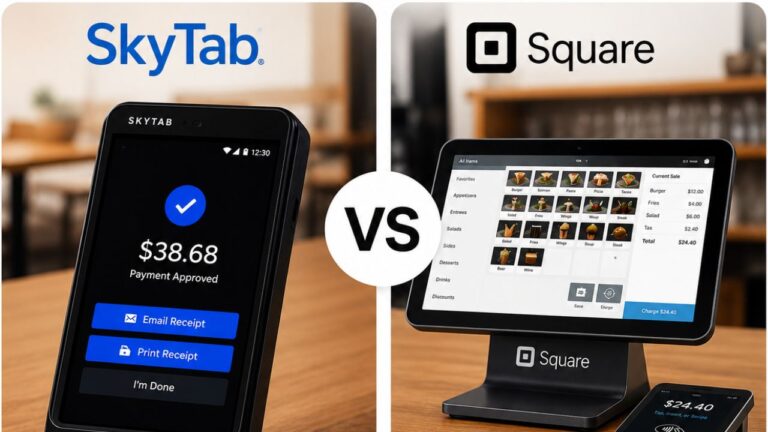
Flat-rate pricing looks clean on paper. When you’re comparing skytab vs square, the first thing most restaurant owners do is glance at Square’s published rate and assume it’s the cheaper option — because the number is right there, no phone call required. But here’s the real question: does “simple to understand” actually mean “costs less when your monthly volume grows”? It doesn’t. And I’ll show you exactly where the math breaks.
Why the Flat-Rate Trap Hurts High-Volume Restaurants
Square built its reputation on simplicity. One published rate for card-present transactions, no monthly minimums to negotiate, no rep to call. For a food truck doing light weekend volume, that’s genuinely fine. But the moment your restaurant starts processing serious card volume — think busy dinner service, catering events, private buyouts — that fixed percentage starts eating margin in a way that compounds fast.
The core problem with flat-rate pricing is that it doesn’t distinguish between card types. A basic debit card costs the processor significantly less to settle than a premium rewards card or a corporate card. With flat rate, you pay the same percentage regardless. You’re effectively subsidizing every high-interchange card in your customer’s wallet.
Here’s where it breaks during a real shift:
- A table pays with a corporate Amex — high interchange, but you’re still charged your flat rate, not the actual cost.
- A regular pays with a basic debit card — low actual interchange, but again, same flat rate. You overpay on this one every time.
- A large group splits the check across five premium travel rewards cards. Each swipe costs you the same flat percentage, even though those cards carry some of the highest interchange categories in the network.
- At close, your batch total looks normal, but the effective cost per transaction on those reward cards was quietly higher than it needed to be.
Multiply that across hundreds of covers per week. The gap between what you’re paying and what you’d pay under a cost-plus model starts to look like a real number on your P&L.
Interchange Plus: What It Actually Means in Practice
Interchange Plus (sometimes called cost-plus) pricing works differently. You pay the actual interchange rate set by Visa/Mastercard/Amex for each specific card type, plus a fixed markup to your processor. That markup is transparent — you can see it on your statement. What you’re not paying is a blended premium that covers the processor’s risk on every card category.
This model rewards volume. As your monthly processing grows, the fixed markup portion becomes a smaller share of your total cost. The interchange component stays tied to actual card network costs, which means you’re not penalized for the fact that your regulars started using premium travel cards.
SkyTab, which runs on Shift4’s payment infrastructure, operates in this space — integrated payments with pricing that’s structured around the actual cost of each transaction rather than a one-size-fits-all rate. Shift4’s model is contract- and deployment-dependent, which means you negotiate based on your volume, card mix, and ticket size. That’s less convenient than seeing a number on a website, yes. But for a full-service restaurant doing consistent volume, the conversation is worth having.
Check these before you decide anything:
- What’s your current average ticket size? Higher average tickets amplify the difference between flat-rate and interchange-plus costs.
- What’s your card mix? If more than half your transactions are rewards or corporate cards, flat rate is likely costing you extra.
- Are you on a monthly software fee model or a free POS with higher processing rates? Some “free” POS hardware pays for itself through inflated transaction fees.
- Do you have visibility into your monthly processing statement — line by line, by card type? If not, you’re flying blind.
The “Square Is Simpler” Objection — and Why It’s Not the Right Frame
I get it. Square’s onboarding is fast. No sales rep, no term commitment on the base plan, hardware ships in a few days. For a new operator still figuring out ticket flow and table management, that friction-free setup has real value.
But “simple” and “cheaper at scale” are different things. Square’s flat-rate model is predictable, not necessarily cost-efficient as volume grows. The moment you start processing the kind of volume a mid-sized full-service restaurant runs on a Friday night, you’re leaving money on the table — sometimes a meaningful amount, month over month.
SkyTab brings restaurant-specific functionality that matters operationally: tableside ordering, tip adjustment flow, kitchen display integration, reporting that actually maps to how a restaurant runs shifts. These aren’t features you layer on top — they’re built into how the system processes a ticket from seat to settlement. That integration matters when you’re trying to reconcile end-of-night and spot a void that happened after batch close (which, by the way, is an edge case that flat-rate systems handle inconsistently — always verify how your processor treats post-close voids before you commit).
Another edge case worth checking: delayed deposit timing. Some processors hold funds longer for new accounts or high-ticket transactions. Verify your deposit schedule in writing — not from a sales deck, from your actual merchant agreement.
How to Actually Compare Costs: A Practical Framework
Don’t compare rate sheets. Compare effective rates — what you actually paid divided by what you actually processed, pulled from three months of statements.
If you’re currently on Square, pull your last 90 days of processing statements and calculate: total fees paid ÷ total volume processed = your effective rate. Then get a quote from a SkyTab/Shift4 partner with your actual volume and card mix data. Run the same math on the quoted structure. The difference, annualized, is your decision number.
When you’re evaluating credit card processing merchant services for a restaurant, the variables that move the needle most are: monthly volume, average ticket, card type mix (debit vs. credit vs. rewards vs. corporate), and whether you’re running tips as a pre-auth or post-auth flow. All of these affect your actual cost under an interchange-plus structure in ways that a flat rate just averages out — usually not in your favor.
A few verification steps before signing anything:
- Ask for a rate quote with your actual card mix, not a generic sample. Any serious processor can run this.
- Confirm whether the quoted markup is tiered or flat across all card categories.
- Check for monthly minimums, PCI compliance fees, batch fees, and statement fees — these are the line items that inflate your effective rate without touching your headline percentage.
- Ask specifically how the system handles offline transactions and what happens to fees if a transaction settles in a different batch than it was authorized in.
The Bottom Line for Restaurant Operators in 2026
Square wins on simplicity. That’s a real advantage, and I won’t pretend otherwise. If you’re early-stage, low-volume, or running a concept where quick setup matters more than cost optimization, Square’s published pricing and fast onboarding are legitimate selling points.
But if your restaurant is processing consistent volume — and especially if your customer base skews toward premium cards — the flat-rate model is structurally more expensive than an interchange-plus alternative. The math compounds. What looks like a small difference per transaction adds up across thousands of covers per month.
SkyTab’s pricing isn’t posted on a public page, and that’s a legitimate friction point. You have to talk to someone, get a quote, do the comparison manually. But that conversation, backed by your actual statement data, is how you find out whether you’ve been overpaying — and by how much.
Run the numbers on your last quarter. If your effective rate is higher than you expected, you already have your answer.
