

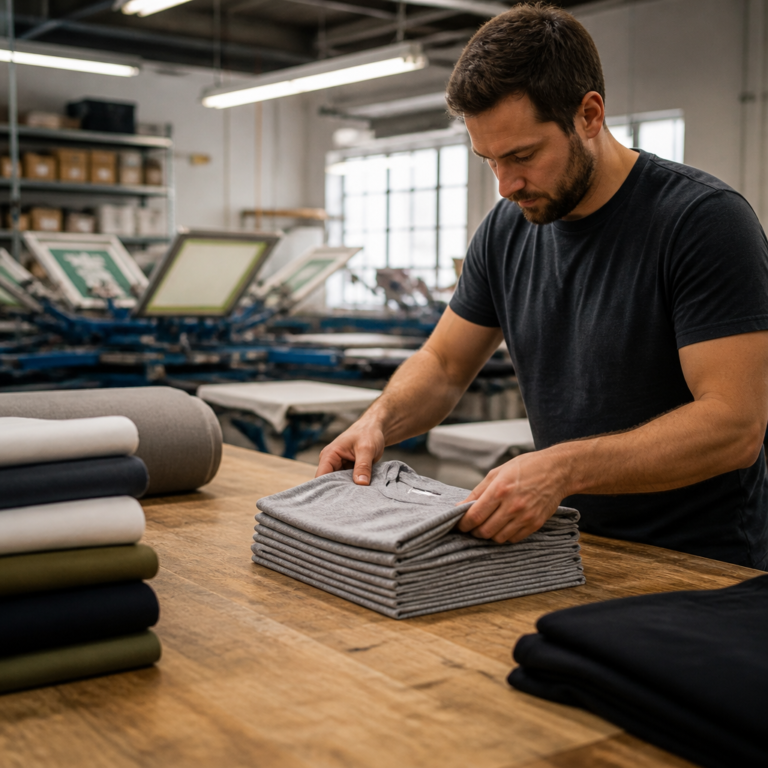
Custom t-shirts have become one of the most versatile tools in modern branding, event planning, and personal expression. Whether you are outfitting a corporate team, launching a streetwear brand, or commemorating a milestone event, the quality of your finished garment depends on decisions made long before the ink ever touches the fabric. Understanding the relationship between material selection, print method, and production partner is what separates a forgettable shirt from one that people actually wear again and again. This guide walks through the essential considerations that every buyer should understand before placing a custom t-shirt order.
Why Fabric Choice Is the Foundation of Every Great Custom T-Shirt
It is tempting to focus immediately on the design — the logo, the colour palette, the typography. But experienced buyers know that the fabric is where quality is either won or lost. A stunning graphic printed on a thin, low-grade blank will pill, fade, and shrink after a handful of washes. Conversely, a simple design printed on a premium fabric will maintain its structure and colour integrity for years.
Cotton remains the dominant choice for custom t-shirts, and for good reason. It is breathable, comfortable against the skin, and accepts most print methods exceptionally well. However, not all cotton is equal. Ring-spun cotton, for instance, is made by continuously twisting and thinning the cotton fibres, resulting in a softer, stronger yarn compared to standard open-end spun cotton. Combed cotton takes this further by removing short fibres and straightening the remaining ones, producing an even smoother surface that is ideal for detailed print work. For those seeking a vintage, worn-in feel, tri-blend fabrics — typically a mix of cotton, polyester, and rayon — offer a lightweight drape and subtle texture that has become popular in lifestyle and fashion-forward applications. Understanding the different types of cotton used in shirting is an essential first step before committing to any bulk custom order.
Print Methods: Matching the Technique to the Design
Once the fabric is selected, the next critical decision is the print method. Each technique has distinct strengths, and choosing the wrong one for your design can result in poor colour accuracy, premature cracking, or an uncomfortable hand feel on the finished garment.
Screen Printing: The Industry Standard for Volume Orders
Screen printing remains the most widely used method for custom t-shirts, particularly for orders involving large quantities and bold, solid-colour designs. The process involves pushing ink through a mesh screen onto the fabric, one colour at a time. The result is a vibrant, durable print with excellent wash resistance. Screen printing is cost-effective at scale because the setup costs are distributed across a larger number of units. However, it is less economical for small runs or designs with many colour gradients, where the complexity of separating and registering each colour increases both time and cost.
Direct-to-Garment Printing: Precision for Complex Artwork
Direct-to-garment (DTG) printing operates much like a standard inkjet printer, but applied directly to the fabric surface. This method excels with photographic images, intricate illustrations, and designs that use a wide spectrum of colours. There are no screens to set up, which makes DTG a practical choice for small runs and one-off pieces. The trade-off is that DTG prints can feel slightly different from screen prints, and the vibrancy on darker fabrics may require a white underbase layer. Pre-treating the garment before printing is also essential for ink adhesion and long-term durability.
Heat Transfer and Embroidery: Specialty Applications
Heat transfer vinyl and sublimation printing offer additional options for specific use cases. Vinyl is popular for names and numbers on sports jerseys, while sublimation works best on polyester fabrics and produces full-colour, all-over prints with no hand feel at all. Embroidery, though technically not a print method, deserves mention for its premium aesthetic — it is particularly effective for logos on polo shirts, workwear, and corporate uniforms where a tactile, professional finish is expected.
For a deeper look at how fabric and print method interact to determine overall garment quality, this guide on choosing the best fabric and print methods for branded t-shirts provides a thorough breakdown that is well worth reading before finalising any order specification.
The Role of a Reliable Production Partner
Even the best fabric and print method will fall short if the production partner lacks the expertise, equipment, or quality control processes to execute consistently. This is where the choice of supplier becomes as important as any design decision. Turnaround time, minimum order quantities, proofing processes, and customer support all factor into whether a custom t-shirt project runs smoothly or becomes a logistical headache.
Fast Shirt Factory is a custom t-shirt production service built around speed, quality, and accessibility. Designed for businesses, event organisers, and individuals who need reliable results without unnecessary delays, the platform streamlines the ordering process from artwork submission through to delivery. With a focus on producing garments that meet professional standards at competitive price points, Fast Shirt Factory has positioned itself as a practical solution for buyers who cannot afford to compromise on either timeline or quality.
Design Considerations That Affect Print Quality
Beyond the technical choices of fabric and print method, the design itself must be prepared correctly to achieve the best possible result. Artwork should always be supplied in vector format where possible, as this allows the design to be scaled to any size without loss of resolution. Raster images should be provided at a minimum of 300 DPI at the intended print size. Colour profiles matter too — designs intended for screen printing should be specified in Pantone colours to ensure consistency across large runs, while DTG artwork is typically prepared in RGB or CMYK depending on the printer’s requirements.
Placement is another consideration that is often overlooked. A design that looks balanced on a flat artboard may sit awkwardly on a finished garment if the print location has not been carefully considered relative to seams, collars, and the natural drape of the fabric. Requesting a physical or digital proof before approving a full production run is always advisable, particularly for first-time orders or complex artwork.
Sustainability and Ethical Sourcing in Custom T-Shirt Production
Increasingly, buyers are factoring sustainability into their custom apparel decisions. Organic cotton, recycled polyester blends, and water-based inks are all options that reduce the environmental footprint of a production run. Certifications such as GOTS (Global Organic Textile Standard) and OEKO-TEX provide third-party assurance that the materials and manufacturing processes meet defined environmental and social standards. For brands that have made sustainability a core part of their identity, these credentials are not optional extras — they are fundamental to maintaining credibility with their audience.
Conclusion: Getting Custom T-Shirts Right From the Start
Creating a custom t-shirt that genuinely impresses requires attention at every stage of the process — from the initial choice of fabric through to the final quality check before dispatch. The decisions made around material, print method, design preparation, and production partner all compound to determine the quality of the finished garment. By approaching each of these variables with care and working with suppliers who share a commitment to consistent standards, it is entirely possible to produce custom t-shirts that reflect well on the brand or occasion they represent, and that people will continue to wear long after the event has passed.
