

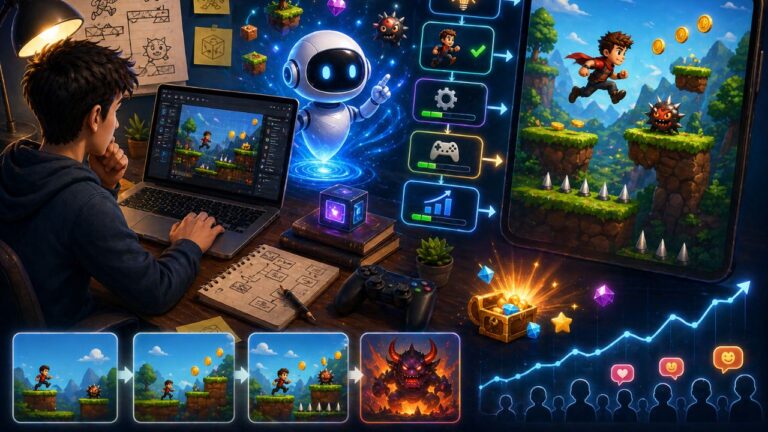
Game development has become far more accessible than ever before because AI tools now allow creators to build complete experiences without writing any code. This means beginners can focus on ideas and gameplay instead of technical complexity. Instead of spending months learning programming, you can now turn simple concepts into interactive games in a much shorter time. Many AI game platforms are helping creators transform written ideas into playable systems, which makes experimentation faster and more creative. The real challenge today is not coding but understanding what makes a game enjoyable and how to design experiences that keep players engaged over time.
What Makes a Game Addictive
A game becomes addictive when it creates a strong loop that keeps players coming back naturally. This loop usually includes a clear goal, simple controls and continuous feedback that rewards the player for their actions. When players understand what they need to do and feel progress with every attempt, they stay engaged longer. Addictive games are not always complex in fact, many of the most successful games are built on very simple mechanics that are polished well. The key is repetition with improvement, where each play session feels slightly better than the last.
How AI Helps You Build Better Games
AI tools simplify game creation by removing the need for manual coding and allowing you to focus on design and structure. You can describe your idea in plain language and the system will generate a playable version that you can refine. This allows you to test ideas quickly and see what works without spending time on technical setup. AI also helps you experiment with different versions of your game so you can improve gameplay flow and difficulty balance. This rapid feedback loop is what makes AI based development powerful for beginners.
Starting with a Strong Game Idea
Every successful game starts with a clear and simple idea that defines what the player will do repeatedly. Beginners often try to create complex systems too early which leads to confusion and weak execution. A strong idea focuses on one core mechanic such as jumping, dodging or collecting items. This simplicity allows you to build a stable foundation and improve it over time. When your idea is clear it becomes easier to design gameplay that feels smooth and engaging because you are not distracted by unnecessary complexity.
Writing Effective Game Prompts
Prompts are the foundation of AI game development because they guide how your idea is transformed into a playable experience. A good prompt clearly explains the main action of the game and then adds details step by step. Instead of describing everything at once you should build your instructions in layers starting from the core mechanic and then adding features like scoring or difficulty progression. This structured approach gives better results and makes it easier to improve your game because each part is added intentionally and can be adjusted separately.
Steps to Build Your First Addictive Game
- Start with one simple mechanic that defines the gameplay loop
- Write a clear prompt that describes the main action
- Generate a playable version using AI tools
- Test the game and observe how it feels in real play
- Improve movement feedback and difficulty gradually over time
These steps help you build a strong foundation while keeping the development process simple and manageable so you can focus on making the experience fun.
Improving Engagement Through Gameplay Design
Engagement comes from how satisfying the core gameplay feels rather than how many features a game has. Small improvements like smoother movement better timing and clear feedback can significantly increase player interest. Adding gradual difficulty progression helps keep players challenged without overwhelming them. When players feel that they are improving with each attempt they naturally continue playing which creates a stronger engagement loop.
Why Simplicity Creates Better Games
Simple games often perform better because they are easy to understand and quick to play. Players do not need long instructions or complex learning curves to enjoy them. Instead, they can immediately focus on gameplay and improvement. Simplicity also makes it easier for developers to refine mechanics and fix issues. When a game has one strong idea it becomes easier to polish and optimize which leads to a more enjoyable experience overall.
Learning from a Simple Game Example
A game like Space Runner shows how a basic idea can become highly engaging when executed properly. The player avoids obstacles while speed gradually increases which creates a natural sense of challenge and progression. The rules are simple but the experience remains engaging because the difficulty evolves smoothly. This shows that addictive gameplay is not about complexity but about how well the core mechanic is designed and balanced over time.
Common Mistakes Beginners Should Avoid
- Trying to build too many features at the start
- Writing unclear prompts that confuse the AI system
- Ignoring gameplay feel and focusing only on visuals
- Skipping testing and not improving based on feedback
Avoiding these mistakes helps you stay focused on creating a strong gameplay experience instead of getting lost in unnecessary details.
Making Your Game More Addictive Over Time
Once your basic game is working you can improve its addictive quality by refining the core loop and adding small motivational elements. This includes score systems, progression rewards and gradual difficulty increases that encourage repeated play. The goal is to make each session feel rewarding so players want to return and improve their performance. When players feel that progress is possible, they naturally engage more deeply with the game.
Testing and Refining Gameplay
Testing is essential because it shows how real players interact with your game. You should play your game multiple times and observe where it becomes boring or frustrating. Feedback from others is also valuable because it highlights issues you might not notice. Each round of testing should lead to small improvements that make the game smoother and more enjoyable. Over time, these refinements turn a simple idea into a polished experience, as seen in Apex Predator.
Wrapping Up
Creating addictive games using AI is now possible without coding experience, as long as you focus on clear ideas and strong gameplay design. The process starts with a simple concept and evolves through structured prompts, testing, and gradual improvement. Addictive games are not built on complexity but on smooth gameplay loops, clear feedback, and balanced progression. AI no-code game maker tools make the technical side easier, but the creativity and refinement still depend on you. With consistent effort, you can turn simple ideas into engaging games that players enjoy and return to regularly.
