

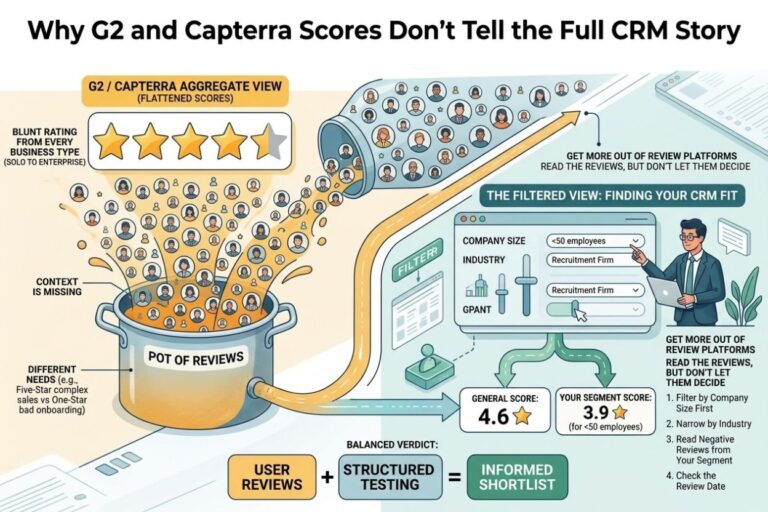
A CRM with 4.5 stars on G2 looks like a safe pick. Thousands of reviews, a solid average, a couple of badges. But that number is pulled from every kind of business that’s ever used the platform. Solo founders, mid-size agencies, massive enterprise teams with 200 reps.
Your five-person recruitment firm and a 500-seat SaaS company have completely different needs, but their ratings all get thrown into the same pot. So how do you actually get something useful out of these platforms? Let’s break down what those scores are hiding and how to read past them.
What Aggregate Scores Actually Measure
G2 and Capterra collect reviews from verified users, and that part is genuinely helpful. The issue is how everything gets boiled down. One number flattens all of that context into a single rating. Someone who gave five stars because the CRM handles complex sales pipelines brilliantly carries the same weight as someone who knocked off a star because onboarding was a nightmare for their small team.
That’s a problem because CRM fit depends almost entirely on context. A platform built for high-volume outbound sales teams will frustrate a consultancy managing 30 long-term client relationships. Both users might leave perfectly honest reviews, but their experiences couldn’t be more different.
The Reviews Are Real, but the Context Is Missing
Most review platforms let users tag their company size and industry, which is great in theory. In practice, hardly anyone actually filters by those tags before making a decision. They’ll glance at the overall score, skim a couple of top reviews, and call it done.
But if you do take the time to filter, the picture often changes quite a lot. A CRM sitting at 4.6 stars overall might drop to 3.9 among companies with fewer than 50 employees. Or it might score brilliantly for tech companies but fall flat for professional services firms that need totally different pipeline structures. Here’s how to get more out of review platforms:
- Filter by company size first. A CRM that works for a 300-person sales org won’t necessarily suit a 10-person team, and the reverse is true too.
- Narrow by industry. Look for reviewers in your sector because their pain points will be much closer to yours.
- Read the negative reviews from your segment. The three-star reviews from companies like yours will tell you far more than the five-star ones from companies nothing like yours.
- Check when the review was written. CRM platforms change quickly. A glowing review from 2022 might be describing a product that’s had two major overhauls since.
Structured Testing Answers a Different Question
There’s a limit to what any volume of individual experiences can tell you, because every reviewer is describing one platform against their own requirements and nobody is testing the same thing twice. CRM reviews built around fixed criteria work the other way round, running every platform through the same set of checks on pipeline customisation, reporting depth and integration options, which produces a fair comparison but not a verdict on your business specifically.
Both have blind spots worth knowing about. Structured testing can’t tell you what a platform is like to live with for eighteen months, and user reviews can’t tell you how it stacks up against the four alternatives that reviewer never tried. Use the testing to narrow a longlist down to three, then go back to the filtered reviews from companies your size to work out which of those three you’d still be happy with next year.
Read the Reviews, but Don’t Let Them Decide for You
G2 and Capterra aren’t broken. They’re just too blunt for a decision that needs more precision. Use them for shortlisting, not for making your final call. Filter aggressively, focus on reviews from businesses that actually look like yours, and then cross-reference what you find with sources that test CRMs in a more structured way. The star rating can get you through the door, but it won’t tell you if you’ll want to stay.
