

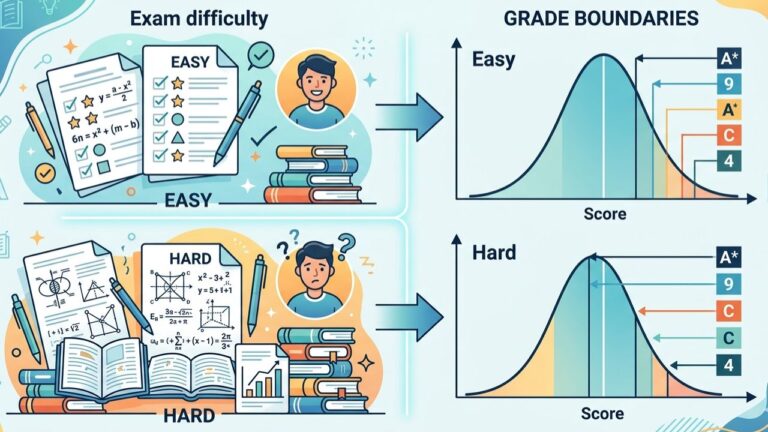
GCSE and A-Level grade boundaries tell you how many marks were needed to get each grade in a specific exam series. They do not simply tell you whether a subject is “easy” or “hard.” A lower boundary usually means the paper was harder, the cohort found it more difficult, or both. A higher boundary usually means students scored more marks overall. To use grade boundaries properly, compare them with past papers, mark schemes, and examiner reports, not in isolation (Ofqual; AQA; OCR; Pearson Edexcel).
What Grade Boundaries Actually Are
A grade boundary is the minimum mark needed for a grade.
For example:
- Grade 9 might start at 78 marks
- Grade 8 might start at 69 marks
- Grade 7 might start at 60 marks
At A-Level, the same idea applies to A*, A, B, C, and so on. If the A boundary is 62 percent one year and 70 percent the next, it does not automatically mean the second year was easier. It means the marks needed to reach that grade changed after the awarding process.
Grade boundaries are published after results are awarded, not before the exam.
Why Boundaries Change From Year To Year
Boundaries move because papers are not perfectly identical every year. Even when exam boards try to keep difficulty stable, one paper may still be slightly more demanding.
Boundaries can change because of:
- harder or easier questions
- unfamiliar question wording
- more demanding source material
- calculation-heavy sections
- cohort performance
- changes in specification or assessment style
Ofqual explains that grade standards are maintained over time by looking at exam performance and statistical evidence, not by forcing the same raw mark every year (Ofqual).
Lower Boundaries Do Not Always Mean An “Easy Grade”
Students often say, “The boundary was low, so it must have been easy to get the grade.” That is usually wrong.
A low boundary often means the paper was difficult. Students scored fewer raw marks overall, so the mark needed for a grade was adjusted down.
For example, if a Maths paper has several unusual problem-solving questions, many students may lose marks. The grade 7 boundary may drop. That does not mean grade 7 became easier. It means fewer marks were needed because the paper was tougher.
Higher Boundaries Do Not Always Mean A Subject Is Easy
A higher boundary can mean students performed well. It can also mean the paper had more accessible questions or clearer wording.
For example, if a Biology paper includes many familiar recall questions, more students may score highly. The boundary for top grades may rise. That does not prove Biology is an easy subject. It shows that in that exam series, more marks were needed to separate higher-performing students.
This is why you should never judge a subject by one year’s boundary.
Why Percentages Can Be Misleading
A raw percentage does not mean the same thing in every subject.
A 65 percent score might be very strong in one A-Level subject and only mid-range in another. Some papers are designed with more challenging application questions, while others contain more direct recall.
This is why students should avoid saying:
- “I need 90 percent for a 9.”
- “A-Level grades are always around 70 percent.”
- “This subject is easier because the boundary is higher.”
The real target depends on the board, subject, paper, and year.
How GCSE Boundaries Differ From A-Level Boundaries
GCSEs use the 9 to 1 grading scale in England, with 9 as the highest grade. A-Levels use A* to E.
The principle is the same, but the pressure points differ.
At GCSE:
- students often compare grade 4, 5, 7, 8, and 9
- boundaries can vary sharply by paper and tier
- Higher and Foundation tiers have different limits in subjects like Maths and Science Students resitting English or Maths outside of the usual GCSE route, for example, through equivalent Functional Skills qualifications, are graded pass or fail, rather than on the 9-1 scale, a different grading system that’s worth understanding in its own right.
At A-Level:
- students often focus on A*, A, and B
- small mark differences can affect university offers
- essay subjects may have more level-based marking variation
Because of this, A-Level students should pay close attention to examiner reports as well as boundaries.
What Boundaries Tell You About Paper Difficulty
Grade boundaries can suggest difficulty when viewed with other evidence.
A useful pattern looks like this:
- boundary drops
- examiner report says students struggled with certain questions
- many students found timing difficult
- mark scheme rewarded more complex reasoning
That combination suggests the paper was probably harder than usual.
But if the boundary drops slightly with no clear report evidence, do not overread it. A small movement may not matter much.
What Boundaries Do Not Tell You
Grade boundaries do not tell you:
- exactly how hard your future paper will be
- which topics will appear next year
- whether your teacher marked your mock harshly or generously
- whether a subject is objectively easy
- how much revision you personally need
They are useful evidence, not a prediction machine.
Students get into trouble when they use boundaries to guess the next exam instead of using them to understand scoring patterns.
How To Use Boundaries For Revision Targets
Grade boundaries can help you set practical goals.
If your target is grade 7 at GCSE or A at A-Level:
- Check the last 3 to 5 years of boundaries for your subject and board.
- Look at the range, not one year.
- Add a safety buffer of 5 to 10 percent.
- Practise until your past paper scores sit above that buffer.
- Track your marks by paper, not only by total score.
For example, if grade 7 usually sits around 58 to 64 percent, aim to practise at 70 percent or above. That gives room for stress, timing slips, and a harder paper.
Why Mocks Should Not Be Compared Too Literally
Mock exams are useful, but they are not always awarded like real GCSEs or A-Levels.
Mocks may differ because:
- schools use older papers
- teachers set custom questions
- grade boundaries may be estimated
- marking may be stricter or looser
- students may not have completed the whole syllabus yet
So if your mock says grade 6, do not panic. Instead, compare the raw marks, timing, and errors with official boundaries and mark schemes.
Use Examiner Reports To Explain Boundary Movements
Examiner reports are the missing context behind grade boundaries.
A boundary tells you the mark needed. The report tells you why students lost marks.
Look for comments such as:
- “many candidates did not answer the command word”
- “students gave general answers without applying to the context”
- “working was not shown clearly”
- “responses lacked evaluation”
- “data was copied but not interpreted”
If a boundary dropped and the report repeats these problems, you know what to fix.
Keep Your Own Boundary Tracker
A simple tracker helps.
Use columns for:
- subject
- board
- year
- total marks
- grade target boundary
- your score
- gap to target
- main error type
- next action
This makes revision more specific. Instead of saying “I need to improve Chemistry,” you can say, “I am 9 marks below grade 8, mostly losing method marks in calculations.”
Keeping Resources In One Place
Grade-boundary analysis works best when it sits next to past papers, mark schemes, and topic practice. A platform like SimpleStudy can help students keep syllabus-matched notes, flashcards, quizzes, past papers, and mock exams together in one place. For UK students preparing for GCSE exams or A-Levels, this makes it easier to practise a paper, compare scores against target ranges, and then revise the weak topic without jumping across several websites.
Common Mistakes Students Make With Boundaries
Avoid these traps:
- treating one year’s boundary as a fixed target
- assuming low boundaries mean an easy grade
- comparing different boards too directly
- ignoring paper difficulty and examiner comments
- using boundaries to predict topics
- aiming exactly at the boundary with no safety margin
The safest approach is to practise above the likely target range.
A Smarter Way To Read Boundaries
Read boundaries in this order:
- What was the raw mark for my target grade?
- How did it compare with the last few years?
- Did examiner reports mention unusual difficulty?
- Which question types caused the most lost marks?
- What score buffer should I aim for in practice?
This turns boundaries into a revision tool instead of a source of panic.
What Students Should Remember
Grade boundaries are not there to scare you. They are there to show how raw marks became grades in a specific series. Used properly, they help you understand paper difficulty, set safer score targets, and judge mock results more realistically.
The best students do not obsess over one boundary. They study several years, read the examiner reports, practise with real papers, and aim above the target range. That is how grade boundaries become useful for revision rather than another thing to worry about.
