

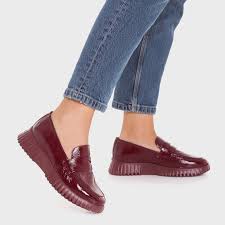
Every autumn has its shoe. We’ve done the chunky Chelsea, the ballet flat revival, the inexplicable return of the kitten heel — and this season, the algorithm and the high street have finally agreed on something your feet will actually thank you for: the loafer mule.
The numbers behind the noise
Search interest tells the story bluntly. UK searches for “loafer mules” have gone from roughly twenty a month last autumn to more than six hundred this summer — a thirtyfold rise, with the sharpest jump landing in June, exactly when the autumn collections started appearing on people’s feeds. “Backless loafers” has more than doubled over the same window. For context, “loafers” on its own pulls around sixty thousand searches a month in the UK, so the mule variant is still a tributary rather than the river — but it is the fastest-moving tributary in the category.
The front rows of the autumn shows explain why. The hybrid slip-on — a loafer’s polished front, a mule’s open back — has quietly become the default shoe of people who look effortlessly put together, and it has done so without a single celebrity endorsement doing the heavy lifting. This one spread the way genuinely useful things spread: someone wore it, someone else asked where it was from.
First, what actually is a loafer mule?
Strip it back and you have a loafer that stops at the instep. The front half keeps everything that makes a loafer a loafer — the apron toe, the vamp strap across the top, sometimes a penny slot or a horsebit — and the back half simply isn’t there. No heel counter, no strap, no fastening of any kind.
That construction is the whole story, both of the appeal and of the pitfalls. It’s the appeal because the shoe goes on in one motion and comes off in less. It’s the pitfall because a conventional shoe distributes the work of holding your foot across the heel, the laces and the upper — and a mule asks the front half to do all of it alone.
Which is why, in this particular trend, construction quality isn’t a snobbery point. It’s the difference between a shoe that works and a shoe that flaps.
A short history of a shoe that isn’t new
None of this is an invention. The mule is one of the oldest shoe shapes in Europe — a backless slipper worn indoors by anyone who could afford to have an indoors, and later a boudoir shoe with a heel and a reputation. The loafer arrived far later, in the 1930s, as a moccasin borrowed from Norwegian fishermen and adopted, inevitably, by American college students who liked the idea of a shoe you could put on without bending down.
Fashion has spliced the two before. The Belgian loafer has spent decades being the shoe of people who don’t need you to know what their shoes cost. Gucci’s horsebit slipper — the backless one — has been in and out of favour since the 1950s. What’s different this time is that the revival arrived from the comfort end rather than the couture end: the backless principle came back through Birkenstock’s Boston, spent three years being extremely everywhere, and then got a polish.
That’s why this version has legs, if you’ll forgive it. Trends that descend from the runway need permission to filter down. Trends that rise up from what people were already wearing don’t need anyone’s permission at all.
Why now?
Blame — or thank — hybrid living. The loafer mule is the footwear equivalent of the blazer-with-jeans formula: smart enough for the office you occasionally visit, easy enough for the school run, and crucially, on and off in one second flat. In a wardrobe era defined by “looks intentional, feels like loungewear”, a backless loafer is less a trend than an inevitability.
There’s also the quiet luxury effect, now several seasons deep and showing no sign of exhausting itself. The loafer mule’s entire appeal is understatement: structured leather, clean lines, no hardware shouting for attention. It photographs like minimalism and wears like a slipper — the exact intersection fashion has been circling since the logo years ended.
And then there’s the honest reason, the one that doesn’t make it into show notes: people are tired. Tired of breaking shoes in, tired of the blister fortnight, tired of choosing between looking assembled and walking normally. A generation raised on Birkenstock’s backless Boston has simply worked out that the slip-on principle also comes in polished leather. The loafer mule is what happens when comfort stops apologising.
How to wear it
The styling rules are mercifully simple.
Show a sliver of ankle. Cropped, tailored trousers are the loafer mule’s natural partner, letting the open heel do its thing. Full-length trousers that break over the shoe hide the very detail you’re paying for.
Straight-leg denim with a precise roll works the casual shift — precise being the operative word, since a shoe this clean makes a sloppy hem look accidental rather than relaxed.
Midi skirts and slip dresses are the underrated pairing. The flat, minimal line stops a floaty hem from tipping into costume, and the exposed heel keeps the whole thing from reading matronly.
Tailoring, head to toe. A loafer mule under a wide trouser is the single easiest way to make a suit look like it wasn’t the plan all along.
Colour-wise, black reads boardroom, while cognac and tan carry the Scandinavian warmth that dominates this season’s palettes — and both age better in leather that’s allowed to develop a patina. If you’re buying one pair, buy the one you’ll still like in three years, not the one that matches this month’s coat.
The sock question, settled
Yes. When the temperature drops, socks are not a compromise, they’re the fashion-forward answer — fine ribbed knits in tonal colours, worn deliberately rather than apologetically. The rule that makes it work: the sock should relate to the trouser or the shoe, not fight both. Tonal beats contrast nine times out of ten, sheer is having a genuine moment, and the only real failure state is the thick sports sock, which turns an elegant silhouette into something borrowed from a hallway.
Practically, socks also solve the one genuine drawback of a backless shoe in a British autumn, which is that your heel is outdoors.
And the men’s version?
Quietly, this is where the trend has the most room left to run. Menswear has been drifting towards the unstructured for years — the soft-shouldered jacket, the drawstring trouser, the trainer at dinner — and a backless leather loafer is the logical footwear conclusion. Worn with a cropped tailored trouser and a plain sock, it reads considered rather than costume.
The practical barrier has been sizing rather than nerve: much of the category is cut on women’s lasts and stops around a UK 8. The brands doing this best are the ones running genuinely unisex ranges across a wide size span, which is a rather elegant solution to a problem the industry created for itself.
The investment question
Should you spend £40 or £180 on the trend? The honest answer lies in how loafer mules are built.
With no laces, no straps and no heel counter doing the work, everything depends on the quality of the front half. Cheap versions use coated split leather — the underside of the hide, sprayed with polymer to look like the top — which creases into cardboard within weeks and, once it cracks, cannot be restored. Better ones use full-grain or vegetable-tanned leather with enough structure to hold its line for years and, crucially, to look better with age rather than worse.
That last point is where the math turns. Do the cost-per-wear sum before flinching at the price tag: a well-made pair worn twice a week for three years costs pennies per outing, while the bargain version repurchased every season quietly becomes the most expensive shoe in the wardrobe. It’s also the more defensible purchase environmentally — the greenest shoe is almost always the one you already own, kept in service.
One tell worth knowing: brands operating a genuine no-discount policy tend to price honestly year-round rather than inflating in September to look generous in January. If a shoe is never on sale, the number on the tag is the number the brand thinks it’s worth.
What to check before you buy
Five checks, none of which take longer than a minute:
- Does the toe box hold its shape when you press it? It should spring back. If it stays dented on the shop floor, imagine it in March.
- Full-grain, vegetable-tanned, or “genuine leather”? The last of those is a marketing term that mostly means split leather. Ask, or check the product page — brands that use good hide say so loudly.
- Can you bend the sole? A shoe you slip into should flex with your foot. A rigid plank in a backless shoe is a recipe for the heel lifting away with every step.
- Does the footbed come out? Removable footbeds can be aired, cleaned and eventually replaced — which extends the life of the whole shoe rather than the shoe ending when the insole flattens.
- Is it comfortable at the end of the day, not the start? Feet swell across a day. Try shoes on late, in the socks you’ll actually wear.
The fit problem nobody mentions
Backless shoes have one failure mode: heel slip. A little movement is normal and correct — it’s a mule, not a boot. Slapping is not.
The fix is counter-intuitive. Most people size up when a mule slips, which makes it worse; the shoe needs to be held at the widest part of the foot, not the longest. Aim for a snug fit where your foot genuinely fills the footbed and the arch sits where your arch actually is. Good leather will give exactly where it needs to over the first few wears. If you’re genuinely between sizes, go up rather than squeezing — but check the width first, because width is usually the real problem.
Who’s doing it well
The designer end has its usual suspects, and the high street has responded at speed. But the interesting action is in the comfort-literate middle: heritage loafer houses cutting backless versions of their classics, and a newer wave of ergonomic brands that spotted the trend’s secret advantage — a shoe you slip into deserves a fit you don’t have to fight.
Finnish label VIBAe’s take on loafer mules is a case in point. Founded in Helsinki in 2020 and handmade in Portugal at a third-generation family-run factory, the brand has built a following on the unglamorous engineering rather than the marketing: vegetable-tanned, chrome-free leather, a flat zero-drop sole, and a removable Carbon Step™ footbed you can replace instead of replacing the shoes. Its backless ROMA is the one to look at — the foot-shaped toe box gives the silhouette its clean Nordic line while leaving your toes room to spread, which is a rarer combination than it sounds in a category that has historically drawn shoes narrowest exactly where feet are widest.
It’s also, quietly, a properly credentialled label rather than a trend-chaser: collaborations with Comme des Garçons across 2024 and 2025, official footwear duties at the Osaka 2025 World Expo, and unisex sizing from 35 to 48, which is more than most It-shoes bother with. Mostly, though, it’s the version of the trend you can still love at 6 pm.
The high street has options too, and some of them are good. But one caution from every leather obsessive we know: a backless loafer lives or dies by its structure. A front that collapses after six weeks turns effortless into shapeless.
Making them last
Vegetable-tanned leather rewards a small amount of attention and punishes none at all. Brush the dust off before it works into the creases, condition occasionally rather than obsessively, and let anything wet dry naturally away from radiators — heat is what actually kills leather, not water. Air the footbed between wears, and alternate with another pair if you can; twenty-four hours off is what lets leather recover its shape.
Do that, and the patina does the styling for you. A three-year-old pair of good tan leather mules looks considerably more expensive than a new pair — which is the entire argument for buying well, compressed into one sentence.
The verdict
Trends that survive are the ones that solve something, and the loafer mule solves several at once: the hybrid dress code, the hands-full doorway, the ache of shoes chosen for looks alone. It works with tailoring and with denim, it goes on in a second, and — bought properly — it gets better rather than worse.
Expect it to outlast the season. Sensible obsessions usually do.
