

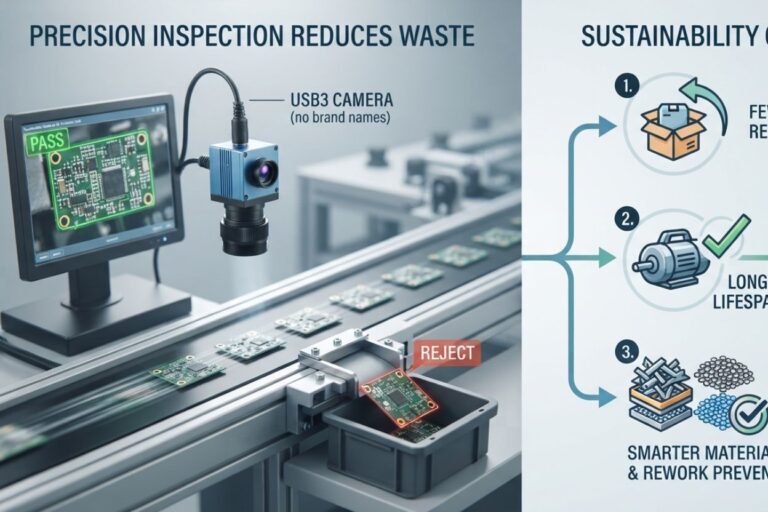
When we talk about sustainable manufacturing, the conversation usually lands on materials, energy and packaging. Far less attention goes to a quieter contributor that sits right at the heart of the process: how carefully products are inspected as they are made. Tools like the industrial USB3 camera have become a standard part of that inspection, checking each item at high speed so that flaws are caught early rather than discovered later. It is not the kind of detail that makes headlines, yet it shapes how much a factory wastes.
The logic is worth sitting with. Every product that leaves a line with a hidden fault represents wasted material, wasted energy and, often, a return or replacement down the road. Imaging specialists such as VA Imaging supply the compact cameras that let manufacturers spot those faults in the moment. The more reliably a problem is caught at the source, the less ends up scrapped, reworked or quietly thrown away.
The Link Between Quality and Longevity
There is a deeper connection between good inspection and sustainability that often goes unspoken. Products that are made consistently well simply last longer. A garment with a sound seam, a device with a properly seated component, a container with a clean seal: these are the things that survive daily use instead of failing early and heading to landfill. When inspection is thorough, fewer weak products slip through, and the items that reach customers are more likely to earn a long life rather than a short one.
That matters because the most sustainable product is usually the one that does not need replacing. Durability rarely happens by accident. It is the result of careful design followed by careful checking, and the checking is where imaging quietly does its part.
How Better Inspection Reduces Waste
It is worth being specific about where the savings actually come from, because the benefits are practical rather than abstract. A well run inspection process cuts waste in several distinct ways.
- Catching faults early: a defect spotted at the first stage costs a fraction of the material and energy of one found after the product is finished.
- Reducing returns: fewer faulty items reaching customers means fewer products shipped back, repackaged and reprocessed, all of which carries its own footprint.
- Less rework: identifying a problem precisely lets a team fix the cause rather than scrap whole batches and start again.
- Smarter use of materials: consistent grading and sorting means good material is matched to the right use instead of being discarded for being slightly off standard.
- Better data over time: because these systems record what they see, manufacturers can find recurring faults and design them out for good.
Individually these gains look small. Across thousands of items they add up to a meaningful reduction in what a factory wastes, which is exactly the kind of unglamorous improvement that genuine sustainability tends to rely on.
A Quiet Shift Worth Watching
It would be a stretch to call inspection technology the hero of sustainable manufacturing, and it is not trying to be. Its role is supporting rather than starring, making sure that the effort poured into better materials and cleaner processes is not undone by avoidable faults. But that is precisely why it deserves a little more recognition. As brands face growing pressure to prove their products are made responsibly and built to last, the humble work of checking each item properly becomes part of the story. The next time a well made product simply does its job for years, it is fair to assume that somewhere along the line, something looked at it very closely first.
