

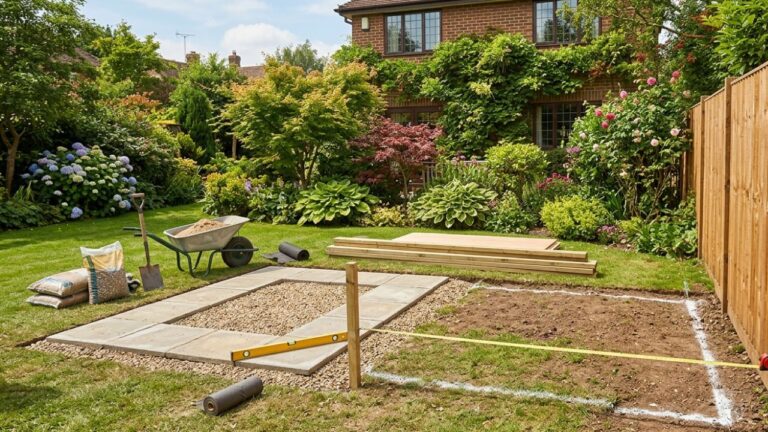
The purchase of a garden shed is usually a pleasurable decision, made in the glow of a summer afternoon with a tape measure and an optimistic eye on a promising corner of the garden. The installation that follows is, ideally, equally uncomplicated — a couple of weekends, a flat base, and a building that goes up cleanly and sits squarely. When things go wrong, however, they tend to go wrong at exactly the stages that received the least thought: the choice of position, the preparation of the base, and — occasionally — the question of whether planning permission was actually required.
None of these issues needs to be a source of anxiety. The rules around garden buildings are, in most cases, straightforward; the principles of good siting are logical once you understand them; and a proper base, while it requires some effort to create correctly, is neither complicated nor expensive. What it does require is that you think about these things before the shed arrives on a lorry, rather than after.
Does Your Shed Need Planning Permission?
The majority of garden sheds in England do not require planning permission, falling instead under Permitted Development rights — a set of rules that allow certain types of building work to proceed without a formal application. However, Permitted Development rights have conditions, and it is important to understand whether your specific situation meets them before you proceed.
Under current rules in England, a garden shed generally falls within Permitted Development if it meets all of the following conditions: it is located in the garden of a house (not a flat or maisonette); it is not situated in front of the principal elevation of the house; it does not cover more than half of the total area of the garden; its maximum eaves height does not exceed 2.5m and its overall height does not exceed 4m (for a dual-pitched roof) or 3m (for any other roof type); and it is not intended for use as living accommodation. There are additional restrictions that apply within designated areas including National Parks, Areas of Outstanding Natural Beauty, and Conservation Areas, where the rules are more restrictive.
These are the England-specific rules; Scotland, Wales, and Northern Ireland each operate under slightly different planning frameworks. If your property falls within any designated area, or if your shed would be unusually large or positioned closer to a boundary or the front of the house than typical, it is always worth checking with your local planning authority before proceeding. The Planning Portal’s guidance on outbuildings and garden buildings provides a clear, up-to-date summary of the relevant Permitted Development rules for England and is the most reliable single source for checking your specific situation.
Boundary Considerations and Neighbour Relations
Even when planning permission is not required, the position of a garden shed in relation to boundaries, neighbouring properties, and shared spaces deserves careful thought. A shed positioned hard against a shared boundary may technically be within Permitted Development but may nonetheless cause friction with neighbours — particularly if it creates significant shade over their garden, if its roofline is directly visible from their windows, or if water runoff from its roof falls onto their property.
As a practical guideline, positioning a shed at least 300mm from any boundary makes maintenance access possible on all sides — something you will appreciate when it comes to treating the rear and side walls, which are otherwise inaccessible. It also avoids any ambiguity about the structure’s footprint encroaching across the boundary line. If your relationship with neighbours is important to you — and most people’s is — a brief conversation about a planned building, before it goes up, is almost always preferable to a less comfortable conversation after.
Choosing the Right Position
Setting aside planning and boundary considerations, the ideal position for a garden shed involves a number of practical factors that are worth thinking through systematically. Access is perhaps the most immediately important: a shed should be reachable with a full wheelbarrow along a firm, level path. This sounds obvious but is frequently neglected, leading to a shed that is slightly inconvenient to use — which means it is used less, and maintained less, than it should be.
Light matters more for wooden sheds than people often realise, and not just for the pleasure of working inside. A shed in deep, permanent shade tends to remain damp, which accelerates timber deterioration and encourages the growth of algae and moss on the exterior. A position with some direct sunlight — even morning sun — dries the structure after rain and maintains better conditions for the timber. Equally, a shed in very full, direct sun on a south-facing aspect can overheat uncomfortably in summer.
The relationship of the shed to drainage is worth considering carefully. Ground that sits wet for extended periods after rain will accelerate floor and wall rot even in a shed on a raised base. If your garden has areas of poor drainage, these are not good positions for a wooden building. Conversely, a position with free-draining soil and no tendency to pond water is ideal.
The Base: Your Most Important Investment
If there is one piece of advice about shed installation that deserves to be stated clearly and unequivocally, it is this: do not skip the base. A wooden shed without a proper, level, well-drained base will not perform as it should and will not last as long as it should, regardless of how well it was built. The base is not an optional upgrade; it is the foundation on which everything else depends.
A concrete slab is the most durable and long-lasting base option. A slab of 100mm thickness on compacted hardcore provides excellent stability, keeps the shed floor clear of ground moisture, and requires no further maintenance. The main investment is time: laying a concrete slab correctly involves preparing the sub-base, creating formwork, mixing or ordering ready-mix concrete, and allowing adequate curing time before the shed is erected.
Paving slabs on compacted hardcore are a viable and somewhat faster alternative. The key requirement is that the slabs are set absolutely level and that the sub-base is compacted sufficiently to prevent settling over time. A shed base that develops a tilt will cause the door to bind, the walls to go out of square, and over time may compromise the structural integrity of the whole building.
Timber frame bases — sometimes supplied with the shed or available as a separate accessory — are a further option and are particularly convenient on sites where laying concrete is impractical. They must be installed on a firm, level surface (compacted gravel or firmly packed hardcore) and the timber must be pressure-treated for ground contact use. They tend to be less durable than concrete over the very long term but are perfectly adequate for most domestic shed installations if properly set up.
Erection Day: Getting It Right
Most wooden shed kits can be erected by two people in a day, assuming a sound base is in place and the instructions are followed carefully. A few general points are worth making. Lay out all components before starting and check against the delivery manifest — discovering a missing component halfway through erection is significantly more frustrating than discovering it at the outset. Read the full set of instructions before beginning, because some sheds have a specific build sequence that is not immediately obvious but that matters for the alignment of the structure.
Ensure the base frame is absolutely square before proceeding: diagonal measurements across opposite corners should be equal. A base frame that is even slightly out of square will result in walls that do not align correctly and a door that may never hang properly. Take the time to get this right before proceeding — it takes ten minutes and saves considerable frustration.
Apply wood preservative to all cut end-grain as you work. Every time you cut a board or trim a component, the exposed end-grain is vulnerable to moisture ingress. Treating it immediately, before it is enclosed within the structure, is one of the highest-value maintenance actions you will ever take for that building.
Making the Purchase
Once you have thought through position, planning, and base requirements, the purchasing decision itself becomes much clearer. You know what size you need, what your site can accommodate, and what features matter for your intended use. Approaching the market with this clarity makes comparison much more productive than browsing by price alone.
When assessing a quality wooden shed for purchase, the specifications to focus on are cladding thickness and type, the section size of the frame, the depth of the roof boards, and whether the floor is included or a separate purchase. These structural details, rather than the photographs, are what determine how the building will perform over many years.
