

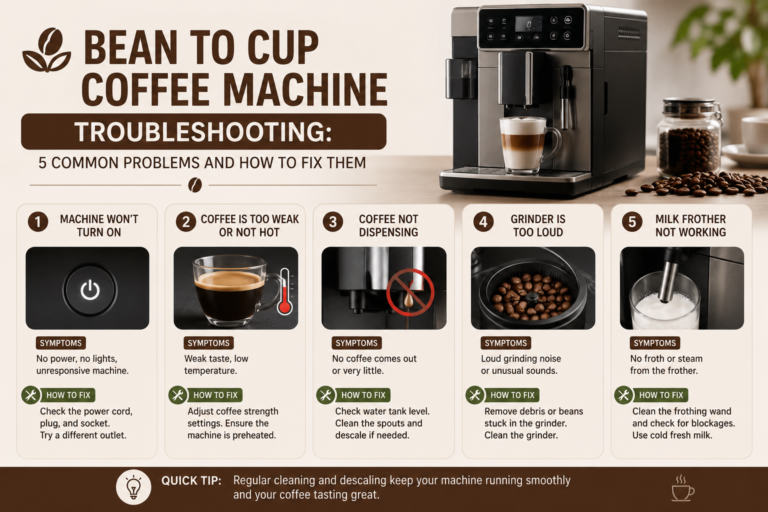
A bean to cup coffee machine for office use gets pushed through far more daily cycles than anything sitting on a kitchen counter, so it is no surprise these machines run into trouble sooner or later. Most problems trace back to five recurring causes: a blocked brew unit, a struggling grinder, limescale buildup, a faulty sensor, or a milk system that needs attention. Once the symptom is matched to the right cause, most of these issues take minutes to sort out rather than a full service call.
Well-built machines still develop faults eventually, that is just mechanical reality, but how often those faults show up often comes down to how the machine was specified in the first place. A properly chosen bean to cup coffee machine copes far better with daily wear than a domestic unit pushed into commercial use, since the brew group, grinder burrs, and pump are all rated for continuous cycles rather than the odd cup here and there.
Here are the five problems that come up again and again, what usually causes each one, and the steps worth trying before booking an engineer.
Most bean to cup machine faults fall into five categories: no coffee dispensing, weak or inconsistent coffee, reduced water flow from limescale, grinder faults, and milk frother problems. Checking the water tank, drip tray, and bean hopper first solves a surprising number of call-outs before any real fault exists.
Problem 1: The Machine Won’t Dispense Coffee
A machine that refuses to brew usually has a blocked brew unit, a jammed ground chute, or an airlock from an empty water tank. Sensors on removable parts can also stop the cycle if a component is not fully seated, even when everything looks fine at a glance.
● Remove and rinse the brew unit under warm water, checking for compacted grounds
● Refill and firmly reseat the water tank to clear any airlock
● Empty the grounds container and check it clicks fully into place
● Confirm the bean hopper and access door are properly closed
If those checks do not solve it, the fault is likely internal, a stuck valve or a failing pump, and it is worth getting a technician involved rather than forcing the machine to keep running. Absolute Drinks provides servicing and support for bean to cup machines across offices and hospitality sites, so sorting out a stubborn fault does not have to mean a long wait or a guessing game.
Problem 2: Coffee Tastes Weak or Watery
Weak, watery coffee almost always points to a grind that is too coarse, a dose that is too low, or beans that have gone stale. None of these are faults exactly, they are settings that have drifted out of line with what the beans need.
● Set the grinder one or two notches finer and pull a test shot
● Increase the coffee dose setting slightly if the machine allows it
● Check the bean hopper for stale or oily beans and replace if needed
● Clean the brew group, since old coffee oils can dull the flavour over time
Problem 3: Slow Flow or Limescale Buildup
Reduced water pressure and spitting from the spout are classic signs of limescale, especially in hard water areas. Professional bean to cup coffee machines are generally fitted with descaling programmes precisely because mineral buildup is the single biggest cause of flow problems over a machine’s lifetime.
● Run the machine’s built-in descaling cycle using the recommended solution
● Fit or replace a water filter cartridge if the machine has one
● Check local water hardness and increase descaling frequency if it is high
Problem 4: Grinder Jams or Grinds Inconsistently
A noisy or jammed grinder is often down to oily beans clogging the burrs, a foreign object like a stone in the hopper, or burrs that have simply worn down after months of daily use. Inconsistent grind size then shows up directly in the cup as uneven extraction.
● Empty the hopper and check for any foreign objects or clumped beans
● Brush out oily residue from the burrs with a dry grinder brush
● Switch to a drier, less oily bean if clogging keeps recurring
● Have the burrs inspected if grinding stays inconsistent after cleaning
Problem 5: Milk Frother Not Working Properly
Blocked milk lines and dirty valves are the usual reason a frother stops producing microfoam or starts spluttering. Milk residue dries quickly inside narrow tubing, so this is one of the fastest problems to develop if daily cleaning gets skipped.
● Run the machine’s auto-clean or milk rinse cycle after every session
● Soak the milk pipe and frothing nozzle in warm water weekly
● Check the milk container seal and tubing for cracks or kinks
Problem Summary at a Glance
The table below sums up the five issues covered here, making it easier to jump straight to a fix once the symptom is clear.
| Problem | Likely Cause | Quick Fix |
| No coffee comes out | Blocked brew unit or airlock | Clean brew unit, refill and reseat water tank |
| Coffee tastes weak or watery | Grind too coarse or under-dosing | Adjust grind finer, increase dose setting |
| Slow flow or spitting | Limescale buildup | Run a full descaling cycle |
| Grinder jams or is noisy | Oily beans or foreign object | Empty hopper, clean burrs, check for debris |
| Milk not frothing | Blocked milk line or dirty valve | Run auto-clean, soak and rinse milk pipe |
When to Call a Professional Instead of DIY Fixing
Basic checks, cleaning, and descaling cover the majority of everyday faults, but any issue involving electrics, water leaks from inside the casing, or a persistent error code after a reset is worth handing to a qualified engineer. Forcing a machine to keep running with an internal fault usually turns a small repair into a much bigger one.
Frequently Asked Questions
1. Why has my bean to cup machine suddenly stopped making coffee?
This is usually a blocked brew unit, an empty or poorly seated water tank, or a sensor that has not detected a removable part correctly, rather than a major fault.
2. How often should a bean to cup machine be descaled?
Most manufacturers recommend descaling every one to three months depending on water hardness, with harder water areas needing more frequent cycles.
3. Why does my coffee taste burnt or bitter?
A grind that is too fine, a dose that is too high, or a brew temperature set too hot are the most common causes of bitter, over-extracted coffee.
4. Can I clean the grinder myself?
Yes, emptying the hopper and brushing out the burrs is safe to do at home, though internal burr replacement is best left to a technician.
5. Why is my milk frother making noise but not producing foam?
Noise without foam usually means a blocked nozzle or air line, which is normally fixed by soaking and rinsing the milk pipe thoroughly.
6. Is it worth repairing an older bean to cup machine or replacing it?
If the brew group and grinder are still sound, repairs are usually worthwhile, but repeated faults on a machine over five years old often signal it is time to replace it.
Final Thoughts
Most bean to cup problems come down to the same handful of causes, so working through water, grounds, grind, and milk in that order solves the majority of issues without any tools beyond a cloth and a descaling solution. Choosing the best bean to cup coffee machine for the volume it needs to handle in the first place also cuts down how often these faults show up at all.
For offices and hospitality sites that want equipment built to handle daily demand along with proper servicing support when something does go wrong, Absolute Drinks offers both the machines and the ongoing care to keep them running smoothly.
