

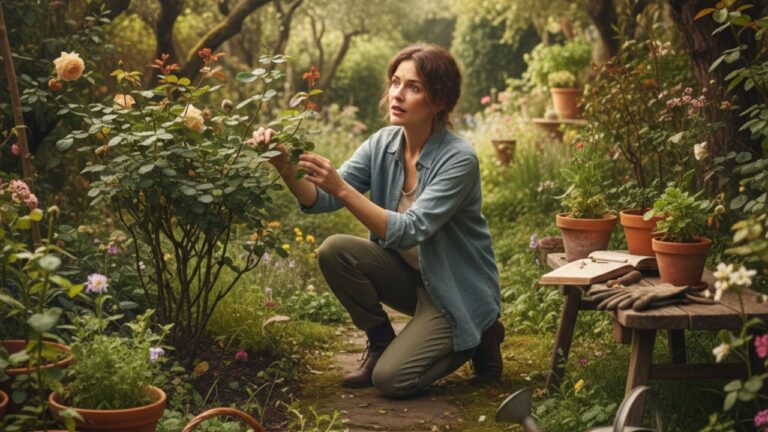
You don’t know what you’ve got yet. That’s the first thing worth saying. The garden you’re looking at right now — whether it’s the overgrown puzzle left by the previous owners, the blank concrete slate of a new build. Or the gently declining space that came with a house you bought in autumn and haven’t yet seen in full leaf — is not the garden you will have in three years. It’s not even close.
This is worth sitting with for a moment, because the temptation when you first acquire a garden is to act immediately. To impose yourself on it. To rip out the things you don’t like and fill the gaps with things you do, as quickly as possible. As if the whole project could be settled in a weekend if only you bought enough compost and moved fast enough.
Resist this. The garden will reward patience in ways it will not reward urgency.
Spend the first year mostly watching. Walk around it at different times of day. Notice where the light sits in the morning and where it has gone by afternoon. Which corners stay damp longest after rain. Notice what comes up in spring that you didn’t plant. Because there will be things, almost certainly, that the previous owners left behind in the soil, waiting. Bulbs you didn’t know were there. A rose that looked dead in February and by May is climbing six feet up the fence. Self-seeded foxgloves appearing in a gravel path with the casual confidence of things that have always belonged.
A garden that has been lived in carries its history in the ground. Your job, in that first year, is to read it.
There will be things you want to change. Of course there will. Perhaps the layout makes no sense to you. There is a concrete path cutting across the lawn at an angle that serves no obvious purpose. Perhaps whoever was here before you had a passion for a particular plant that you find deeply unappealing, and it is now in twelve places simultaneously.
Make notes. Make sketches if that helps. But before you remove anything substantial — a mature shrub, an established climber, a tree that seems too large for the space — ask yourself what it is doing. What else is growing in its shade. Whether the birds are using it. Whether, in a different season, it might be something you would miss.
Gardens accumulate wisdom slowly and lose it very quickly. The hedge that looks like overgrown nuisance may be doing more for the privacy and the wildlife and the microclimate of your plot than you will fully appreciate until it is gone. Remove it by all means, if you’ve thought it through — but remove it with full knowledge of what you’re trading, not in a moment of early enthusiasm that you can’t undo.
The things most worth keeping are usually the oldest ones. A twenty-year-old apple tree. A wisteria that has taken a decade to cover its wall properly. A yew that was probably planted before anyone currently alive remembers. These things cannot be replaced on any reasonable timescale. They are, in a very real sense, the garden’s most valuable assets.
You will make mistakes. This is not a warning so much as a promise. You will plant something in the wrong place and spend two years moving it around the garden trying to find where it actually wants to be. Buy something in a nursery because it was beautiful and discover three months later that it needs conditions you cannot provide. Underestimate how large things get. You will overestimate how quickly they get there. You will sow seeds at the wrong time, in the wrong compost, at the wrong depth, and watch nothing happen, and then try again.
This is fine. This is, in fact, the whole thing. Every experienced gardener you will ever meet has done all of these things and more. What separates them from beginners is not that they stopped making mistakes — it’s that they stopped being discouraged by them.
Gardening is the practice of trying things, observing what happens, and adjusting. The plants are endlessly informative if you’re paying attention. A yellowing leaf is telling you something. A plant that hasn’t moved in two years despite apparently ideal conditions is telling you something. A plant that has self-seeded into a crack in the paving, away from the bed you carefully prepared for it, is telling you something extremely clearly about where it actually prefers to be.
Listen to the garden more than you talk to it. That is most of the advice, honestly.
Practicalities, since we should cover those too.
The thing most new gardeners underestimate is not the planting — they think about the planting endlessly — but the infrastructure. The shed. The paths. The edges. The places to put things, to do things, to stand while you’re working. These are not glamorous considerations, but they are the ones that determine whether the garden is genuinely usable or perpetually frustrating.
A decent shed, positioned thoughtfully, changes your relationship with the garden considerably. Not just as somewhere to store tools — though having tools accessible and dry matters more than it sounds — but as a base of operations. Somewhere to pot on seedlings, to keep a bag of compost handy, to stand out of a sudden shower without abandoning what you were doing. If you don’t have one, or the one you’ve inherited is beyond saving, it’s one of the more worthwhile early investments you can make. Take a look at what’s available at Dobbies — they carry a range that goes well beyond the standard flat-pack, and seeing the different sizes and construction options in one place makes it much easier to work out what would actually suit your space.
Paths, similarly, seem boring until you’ve spent a wet November walking across muddy grass to get to the compost bin. Even a simple mown grass path or a line of stepping stones changes the way you move around and use the garden. Good design is often just making the things you do every day slightly less annoying.
Somewhere in the middle of your second or third season, something will happen that is difficult to describe to people who haven’t experienced it. You will walk out into the garden on a morning — probably a morning in May or June, when everything is growing fast and the light is long — and you will feel, for the first time, that it is yours. Not owned in the legal sense, which it already was, but known. Understood. A place whose rhythms and habits and quirks you have begun to internalise without entirely realising it.
You will notice that you know, without checking, what needs water and what doesn’t. That you can see from the kitchen window that the sweet peas need tying in. That the bird you’ve been hearing in the mornings is a blackbird and it nests in the pyracantha and you know this because you’ve watched it, over months, going back and forth.
The garden by that point will be a completely different place to the one you inherited. Not because you’ve done a great deal to it — though you will have. But because your understanding of it has deepened. You will have learned its moods and its seasonal rhythms and its peculiarities. You will know which corner goes dry fastest in summer and which one stays frosted longest in spring and which plant is quietly trying to take over and needs watching.
This knowledge is the real thing. The plants are lovely. The structure and the design and the right plants in the right place all matter. But the knowledge — the accumulated, specific, particular understanding of this one piece of ground — is what turns a garden into a garden rather than just an outdoor space.
It takes time. Everything worth having in a garden takes time. But it comes, if you let it, and when it does, you will find that the garden has become one of the most restorative things in your life. Not because it is always beautiful or always well-behaved. But because it is always there, always honest, always showing you exactly where you are in the year.
That is worth quite a lot.
Welcome to it.
