

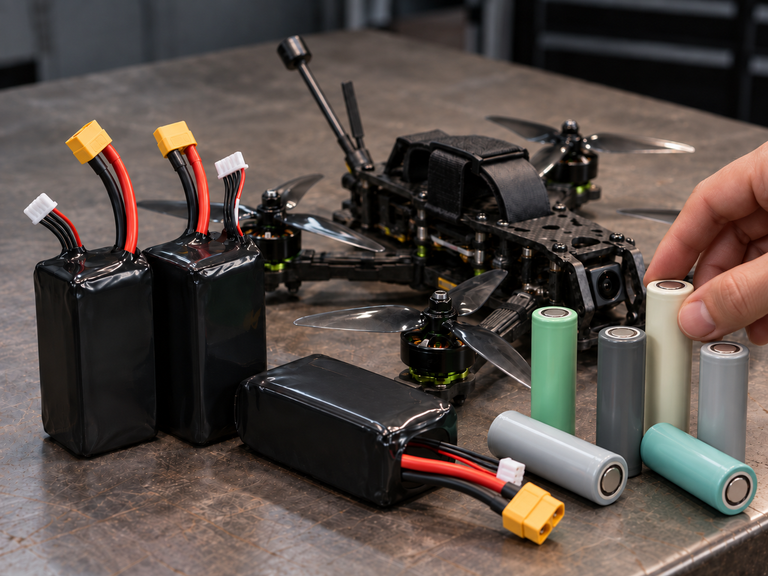
Most of what I know about drone batteries came from ruined cells. A pack puffing 400 meters out. A “5000mAh” cell sagging so hard under throttle that the quad dropped like a stone. Spec sheets don’t teach you that. Crashes do.
Below is my ranked top 8 drone batteries — Li-ion cells for long-range builds, LiPo packs for freestyle and racing — with the reasoning behind every spot.
Pick the chemistry before the brand
LiPo: punch over endurance
LiPo still owns 5-inch freestyle and racing. A 6S 1100–1300mAh pack from CNHL, GNB, Tattu or Ovonic dumps 100+ amps without complaint, and that punch is the whole point. Flight time? Four to six minutes.
Li-ion: endurance over punch
Li-ion flips the trade. Energy density goes up and the discharge ceiling comes down, so a 7-inch long-range quad that managed 7 minutes on LiPo does 20–25 on a 6S2P 21700 pack. Hammer the throttle, though, and voltage collapses. That’s chemistry, not a bad cell.
LiHV: the middle ground
LiHV sits in between. Charged to 4.35V per cell instead of 4.2V, it gives roughly 10–15% more usable energy — but only if your charger has a real LiHV mode. Plenty of older ones don’t.
Which one to choose
My rule: if the drone lives above 60% throttle, fly LiPo. If it cruises, build Li-ion. The ranking below mixes both, so read the “Best for” column before you look at the price.
Top 8 drone batteries, ranked
| # | Battery | Type | Capacity (mAh) | Rated discharge | Best for |
|---|---|---|---|---|---|
| 1 | Molicel P50B | Li-ion 21700 cell | 5000 | 60A | Heavy 8–10″ long-range |
| 2 | Tattu R-Line v5.0 6S | LiPo pack | 1300 | 150C | 5″ racing |
| 3 | Molicel P45B | Li-ion 21700 cell | 4500 | 45A | 7″ long-range |
| 4 | CNHL Black Series 6S | LiPo pack | 1300 | 100C | 5″ freestyle on a budget |
| 5 | EVE 50PL | Li-ion 21700 cell | 5000 | 50A | Value long-range |
| 6 | GNB 6S LiHV | LiHV pack | 1100 | 120C | Weight-sensitive racing |
| 7 | Samsung 40T | Li-ion 21700 cell | 4000 | 35A | 4″ micro long-range |
| 8 | LG M58T | Li-ion 21700 cell | 5570 | 12.5A | Fixed-wing endurance |
1. Molicel P50B
Top of the pile right now. 5000mAh at 60A continuous finally puts capacity and punch in one cell. In a 6S2P pack that’s 120A of headroom, more than most long-range ESCs will ever ask for. It costs more per cell, and it earns that on 8–10-inch frames pulling 40A+ on climb-out.
2. Tattu R-Line v5.0 6S 1300mAh
The race-day pack. Nobody’s LiPo actually sustains 150C — treat the label as marketing — but R-Line packs hold voltage through a full race better than almost anything else on the gate. Expect roughly 220–230g. Racing packs live hard, so budget for replacing them sooner than you’d like.
3. Molicel P45B
Same 45A rating as the Molicel P42A, the long-time long-range benchmark, with 300mAh more on top. Building fresh today, I’d take this one. The extra capacity comes free.
4. CNHL Black Series 6S 1300mAh
Cheaper than Tattu or GNB, and closer in performance than the price gap suggests. For freestyle — where a pack eventually meets a concrete ledge — that’s the smart money. You’ll feel the sag in the last minute of hard punch-outs. That’s the trade.
5. EVE 50PL
The value answer to the P50B: 5000mAh, 50A, noticeably cheaper. On a 7-inch cruiser averaging 15–25A, you won’t feel the difference. Your wallet will, especially on a 24-cell order for two 6S2P packs.
6. GNB 6S 1100mAh LiHV
A smaller pack charged to 4.35V per cell, so it weighs less than a 1300 while giving back much of the flight time. Racers chasing every gram run these. Plug one into an old 4.2V charger and you leave the whole advantage on the table.
H3 7. Samsung 40T
An older cell, still worth knowing. 4000mAh at 35A, a few grams lighter than the 5000mAh generation — and that matters on 4-inch micro long-range builds running 6S1P. Newer Molicels beat it on paper. Thousands of reliable packs still run it.
8. LG M58T
An energy cell: 5570mAh, only 12.5A. It shines on a fixed-wing cruising at 8–10A, or in a 3P pack where three cells split the load. On a 1P multirotor pack it’ll sag and cook. Don’t.
Turning cells into a pack
Series, parallel and weight
Parallel groups add current. A 6S2P pack of P42A gives 8400mAh and 90A; the same cells in 6S1P give 4200mAh and 45A. Weight is where people get caught — each 21700 runs about 70g, so twelve cells land near 840g before nickel and shrink. Strap that onto a frame tuned for a 250g LiPo and the whole flight feel changes.
Connectors
Check the plug too. XT60 is rated around 60A continuous, so a 2P pack capable of 90A cooks the connector long before the cells notice. Go XT90.
Welding and matching cells
Never solder straight onto a cell. Spot-weld with pure nickel strip, 0.15mm or thicker, because nickel-plated steel looks identical and carries several times the resistance. Easy test: salt water on an offcut overnight. Plated steel rusts; pure nickel doesn’t. Match cells to within 0.02V before welding, and add fish-paper rings on every positive end — the cap sits millimeters from the negative can. A cheap IR meter pays for itself here: the cell reading well above its siblings is the one that dies first and drags the whole pack down with it.
Charging, storage and where to buy
Charging and storage
Landing around 3.0V per cell under load is normal for Li-ion; LiPo should come home at 3.5V. Charge Li-ion at 0.5C or below — about 4A for a 2P 8400mAh pack — and always through the balance lead. Store Li-ion near 3.6–3.7V. A full pack left in a hot car over a weekend loses cycles it never gets back. Cold hurts too — below about 5°C, sag gets noticeably worse, so keep packs in an inside pocket until takeoff.
When to retire a pack
Retire anything that puffs or loses more than about 20% of its flight time. One more flight on a tired pack is how drones end up in trees.
Avoiding fake cells
Fake cells are everywhere: cheap cells rewrapped with a counterfeit label and an inflated capacity figure. A listing for a 21700 at 9900mAh is the giveaway — no such cell exists. Buy from a distributor that sources straight from manufacturers and ships under lithium transport rules, and check a specialist drone batteries catalog before you plan a build around one cell. Popular Molicels sell out fast.
