

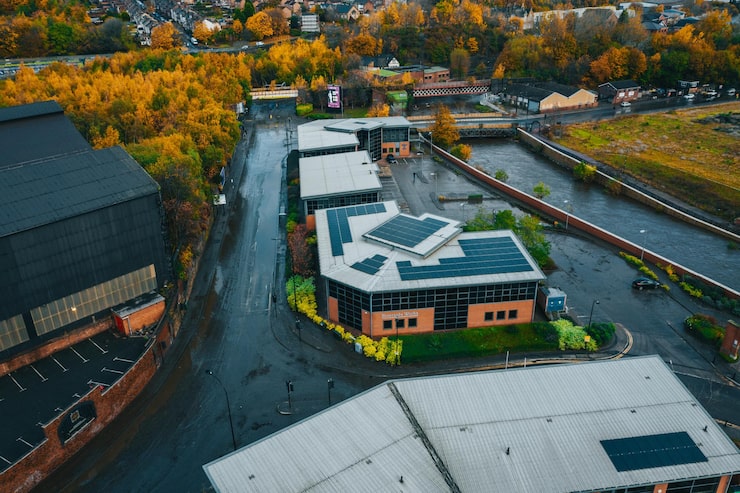
For many businesses, the roof is simply part of the building. It keeps the weather out, supports ventilation systems and is rarely thought about unless repairs are needed.
But for companies with suitable commercial premises, the roof can potentially do much more. Warehouses, factories, offices, schools and other large buildings often have significant unused roof space that could be used to generate electricity.
For businesses across Yorkshire, where energy costs can have a major impact on operating margins, treating roof space as an energy asset can be a practical way to think about long-term energy strategy.
Large Commercial Roofs Have Untapped Potential
Commercial buildings often have one major advantage over homes: scale.
A warehouse, industrial unit or school may have a large roof area with relatively few obstructions. That can create far more usable space for solar generation than is available on a typical residential property.
Potentially suitable buildings can include:
- Warehouses and distribution centres
- Manufacturing and engineering sites
- Offices and business parks
- Schools and education buildings
- Retail and hospitality premises
The key is not simply having a large roof. Orientation, shading, roof condition, structural suitability and electricity usage all need to be considered before deciding whether solar is appropriate.
Daytime Energy Use Can Work Well with Solar
Many businesses use a significant amount of electricity during daylight hours, which is also when solar panels are generating.
Offices run computers, lighting and air conditioning. Factories operate machinery. Warehouses use lighting, ventilation and equipment. Schools and commercial kitchens can also have substantial daytime electricity demand.
This overlap can be useful because electricity generated on site may be consumed directly by the business rather than being exported.
The more closely generation matches demand, the more useful the system can potentially become as part of everyday operations.
Roof Space Can Help Offset Operating Costs
Commercial property owners often think carefully about how every square metre of internal space contributes to the business. Roof space is rarely viewed in the same way.
Solar changes that.
A previously passive part of the property can potentially contribute towards electricity generation and help offset some of the energy that would otherwise need to be bought from the grid.
For businesses considering commercial solar panels for businesses in Yorkshire, this can turn unused roof space into part of a wider strategy for controlling energy costs and improving the performance of the building.
Yorkshire Has a Wide Range of Suitable Commercial Buildings
Yorkshire has a strong mix of industrial, manufacturing, logistics, retail and commercial property.
From large industrial units around Sheffield and Rotherham to warehouses, business parks and educational buildings across the wider region, many premises have the kind of roof space that may be worth assessing for solar.
Of course, location alone does not determine whether a project makes sense. A proper assessment still needs to consider the individual building, electricity profile and roof condition.
The important point is that many commercial properties already have a large physical asset sitting unused above them.
Battery Storage Can Extend the Value of Generation
Solar generation does not always line up perfectly with business demand.
Some companies may generate more electricity than they need during certain parts of the day, while energy use continues into the evening or overnight.
Battery storage can help in some situations by storing excess electricity for later use.
Potential benefits may include:
- Using more electricity generated on site
- Reducing reliance on grid electricity at certain times
- Supporting businesses with extended operating hours
- Making better use of variable generation
Battery storage is not automatically necessary for every commercial solar project. Whether it makes financial sense depends on the company’s usage pattern, tariff and system design.
Energy Data Should Shape the System
A commercial solar system should not simply be designed around how many panels can physically fit on the roof.
Electricity consumption matters just as much.
Looking at historic energy usage can help establish when electricity is being consumed, how much demand exists during the day and whether generation is likely to align with that demand.
A business operating heavily from 8am to 6pm may have a very different opportunity from a site that uses most of its electricity overnight.
Good system design starts with understanding the building and the business behind it.
Roof Condition Should Be Checked First
Solar panels are a long-term installation, so the roof beneath them needs to be suitable.
If a commercial roof is approaching the point where major repairs or replacement will be needed, it may make sense to deal with that work before installing panels.
Structural capacity, roofing material, access and drainage should also be considered.
Planning the roof and solar project together can help avoid the disruption and expense of removing panels later to complete building work that could have been handled beforehand.
Solar Can Support Wider Sustainability Goals
For some businesses, energy generation is not only about reducing costs.
Customers, employees, investors and supply-chain partners are increasingly interested in how organisations manage energy use and environmental impact.
Generating electricity on site can form part of a broader sustainability strategy alongside measures such as:
- LED lighting upgrades
- Better insulation
- Efficient heating and cooling
- Electric vehicle charging
- Energy monitoring
Solar should not be treated as a substitute for general energy efficiency, but it can work alongside these measures as part of a more joined-up plan.
Think Beyond the Immediate Payback
Financial return is naturally important, but commercial solar decisions are often better viewed over the longer term.
Electricity demand may increase as businesses adopt EV fleets, heat pumps, automation or additional equipment. Energy tariffs may also change over time.
A properly designed system can therefore become part of the building’s long-term infrastructure rather than simply a short-term cost-saving measure.
This makes future demand an important part of the initial conversation.
Final Thoughts
For Yorkshire businesses with suitable commercial premises, the roof can be more than unused space.
It can potentially become part of the company’s energy infrastructure, helping generate electricity during working hours, reduce dependence on grid supply and support broader sustainability plans.
The strongest commercial solar projects are based on the building’s actual energy use, roof condition and future plans. When those factors align, a large commercial roof can become an asset that works for the business rather than simply sitting above it.
