

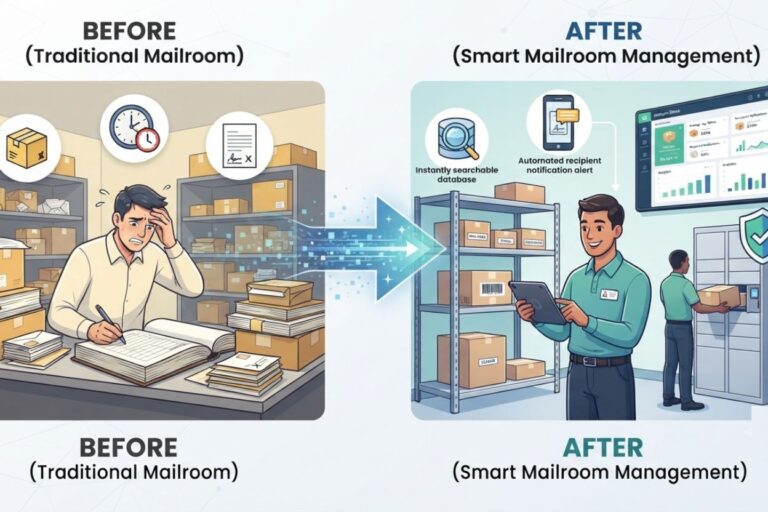
Businesses have spent years modernizing customer service, finance, and human resources through digital transformation. Yet one area has often remained overlooked: the mailroom.
For many organizations, the mailroom is still managed with handwritten logs, spreadsheets, or disconnected processes that were designed for a time when incoming deliveries were far less frequent. Today, workplaces receive a steady flow of documents, equipment, and employee parcels, making manual processes increasingly difficult to sustain.
Implementing digital mailroom software allows organizations to streamline daily operations, improve accountability, and create a more efficient experience for both mailroom teams and employees.
A well-managed mailroom is no longer just an operational necessity. It is a business function that directly supports productivity, security, and workplace efficiency.
The modern mailroom has changed
The role of the mailroom has evolved significantly over the past decade. While traditional letter volumes have declined, package deliveries have increased as online purchasing, hybrid working, and direct-to-office shipping have become commonplace.
This shift has placed greater demands on mailroom teams. Staff are expected to receive deliveries, record accurate information, notify recipients promptly, maintain secure storage, and provide proof that every item reaches the intended recipient.
Without a structured process, these responsibilities become increasingly difficult to manage as delivery volumes grow.
Mailroom management is no longer simply about sorting incoming items. It is about maintaining visibility, accountability, and consistency throughout every stage of the delivery process.
Why do manual processes create unnecessary challenges
Many businesses continue to rely on manual systems because they have always worked. However, as delivery volumes increase, these methods often become the source of avoidable problems.
Common issues include:
- Lost or misplaced deliveries
- Delayed recipient notifications
- Incomplete delivery records
- Difficulty locating items quickly
- Limited visibility into outstanding collections
- Time spent on repetitive administrative tasks
Even small inefficiencies can accumulate over time, creating frustration for employees and increasing pressure on mailroom staff.
Manual processes also make it more difficult to answer simple questions such as when an item arrived, who accepted it, or whether it has already been collected.
How mailroom management software improves daily operations
Mailroom management software replaces manual record keeping with a digital workflow that captures information as deliveries arrive.
Instead of recording details on paper or in spreadsheets, staff can scan items, assign them to recipients, and create an instantly searchable electronic record.
The benefits extend well beyond convenience.
| Traditional Mailroom | Digital Mailroom Management |
| Paper logbooks | Digital delivery records |
| Manual notifications | Automated recipient alerts |
| Physical signature sheets | Electronic proof of collection |
| Time-consuming searches | Instant record retrieval |
| Limited reporting | Real-time operational insights |
These improvements help mailroom teams process deliveries more efficiently while reducing the likelihood of human error.
Better visibility creates greater accountability
One of the greatest advantages of modern mailroom management is visibility.
Every delivery generates a digital record that documents when it arrived, who accepted it, who it belongs to, and when it was collected. This creates a complete history for every item handled by the mailroom.
For organizations managing valuable equipment, confidential documents, or sensitive deliveries, this level of transparency provides reassurance for both employees and management.
When questions arise, staff no longer need to search through paper records or rely on memory. Information can be located within seconds.
This visibility also strengthens accountability by ensuring every delivery follows a documented process from arrival through collection.
The most effective mailrooms are built on visibility. When every delivery can be tracked, accountability becomes part of the everyday workflow.
Supporting today’s hybrid workplace
Hybrid working has changed how employees interact with the workplace.
Many staff members are only present in the office on selected days, making clear communication around incoming deliveries more important than ever.
Mailroom software helps address this challenge by automatically notifying recipients when items are ready for collection. Employees receive timely updates without requiring additional administrative work from mailroom staff.
The result is fewer uncollected deliveries, less storage congestion, and a smoother experience for everyone involved.
As workplaces continue to adapt to flexible working arrangements, digital communication has become an essential part of effective mailroom management.
Security and compliance matter more than ever
Security is another area where digital mailroom management delivers measurable value.
Whether handling confidential documents, IT equipment, legal correspondence, or high-value packages, organizations need confidence that every item is properly recorded and securely distributed.
Mailroom management software creates an auditable chain of custody by recording:
- Delivery time and date
- Recipient information
- Collection confirmation
- Electronic signatures
- Complete delivery history
These records support internal accountability while helping organisations meet governance and compliance requirements where accurate documentation is essential.
Rather than relying on fragmented paperwork, businesses gain a reliable digital audit trail that can be accessed whenever required.
Future-ready businesses are investing in smarter mailrooms
As organizations continue to modernize workplace operations, the mailroom is becoming an increasingly important part of the employee experience.
Businesses are recognizing that efficient mailroom management reduces administrative effort, improves service levels, strengthens security, and provides greater operational visibility.
Digital tools also allow mailroom teams to manage growing delivery volumes without significantly increasing manual workloads, making them well suited for organizations planning for future growth.
The mailroom may operate behind the scenes, but its impact is felt across the entire organization. By replacing outdated processes with modern mailroom management software, businesses can create a workplace that is more efficient, accountable, and prepared for the demands of today’s working environment.
