

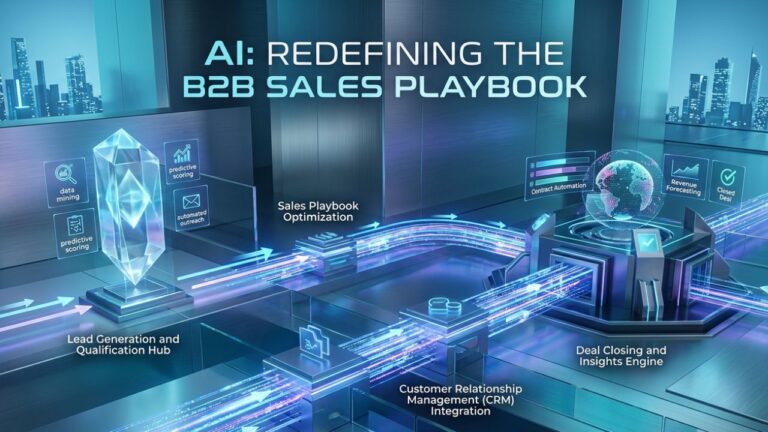
The sales function has always been about timing, relevance, and persistence. A rep who reaches the right buyer with the right message at the right moment wins. Everyone else leaves voicemails that go unanswered. For decades, “better timing” meant more headcount, more dialers, and more coffee. In 2025, it means deploying an ai sales agent that never sleeps, never loses context, and never forgets to follow up.
This is not a story about robots replacing salespeople. It’s about what happens when the most repetitive, data-intensive parts of the sales process get automated — and human reps are freed to do the one thing machines still can’t replicate: build genuine trust.
The Pipeline Problem Nobody Talks About
Every B2B sales leader knows the funnel leaks. Leads come in from content, paid ads, outbound sequences, and partner referrals. Then they go quiet. The SDR team is stretched. The follow-up cadence slips. A prospect who was 70% ready to book a call last Tuesday has already signed with a competitor by Thursday.
The traditional fix is to hire more SDRs. But SDR turnover is brutal — industry averages hover around 35% annually — and ramp time eats six to eight weeks before a new hire contributes meaningfully. You’re running to stand still.
The deeper problem is structural: qualification and nurturing are fundamentally high-volume, low-variance tasks. The questions a prospect asks at the top of the funnel — “What does your platform do?”, “How long is implementation?”, “Do you integrate with Salesforce?” — are the same across thousands of conversations. Human reps are answering the same questions on repeat while genuinely complex, high-value conversations wait.
AI changes this equation entirely.
What an AI Sales Agent Actually Does
The term gets used loosely, so it’s worth being precise. An ai sales agent is an autonomous software system that can engage prospects in real time, qualify them against defined ICP criteria, handle objections, schedule meetings, and update your CRM — without a human in the loop for each interaction.
Modern implementations go well beyond chatbots that redirect users to FAQ pages. Today’s agents:
- Engage inbound leads within seconds, not hours. Research from Harvard Business Review found that responding to a lead within five minutes increases qualification rates by up to 9x compared to a 10-minute delay. AI doesn’t have a five-minute delay.
- Personalize at scale using intent signals, firmographic data, and behavioral history. An agent can reference a prospect’s recent LinkedIn post, their company’s funding round, or the specific blog post they read before filling out a demo form.
- Qualify using multi-variable logic — not just “are they in the right industry?” but budget indicators, tech stack compatibility, organizational decision-making structure, and urgency signals.
- Hand off to human reps with full context preserved. When the meeting is booked, the SDR or AE receives a summary of every exchange, every question asked, and every concern raised. Cold handoffs become warm ones.
This is the practical reality of AI-assisted sales in 2026: the agent handles the volume, the human closes the deal.
The Role of Conversational AI in the Sales Stack
Underlying most of these agent capabilities is a broader category of technology: conversational ai software. This is the infrastructure layer — the NLP models, dialogue management systems, and integration frameworks — that allows AI to understand natural language, maintain conversation context across multiple turns, and respond in ways that feel coherent rather than scripted.
Conversational AI has matured dramatically in the last three years. Early implementations were brittle: they worked beautifully on the demo scenarios they were trained on and collapsed the moment a prospect deviated from the script. If someone asked a question the bot didn’t recognize, the system either looped back to a canned response or escalated immediately to a human — which defeated the purpose.
Modern conversational ai software is fundamentally different. Large language models (LLMs) power dialogue systems that can handle ambiguity, infer intent from incomplete input, and generate contextually appropriate responses to questions the system has never explicitly seen before. They can hold context across a 45-message conversation. They can recognize when a prospect’s tone has shifted from curious to frustrated and adjust accordingly.
For sales specifically, this means:
- Multi-turn qualification flows that feel like conversations, not interrogations
- Objection handling that goes beyond surface-level rebuttals to address the actual concern behind the objection
- Language localization that allows global teams to run consistent qualification processes across markets without building separate bot instances for each language
- Integration with CRM and sales engagement platforms so every conversation is logged, scored, and actioned automatically
The gap between “chatbot” and “conversational agent” is the gap between a vending machine and a knowledgeable sales consultant. One dispenses pre-packaged answers. The other engages.
Use Cases Across the Sales Funnel
Top of Funnel: Inbound Response and Qualification
This is where the ROI is most immediate and most measurable. When a prospect submits a demo request form at 11:47 PM on a Friday, an AI agent responds within seconds, begins qualification, and can have a meeting booked by the time your sales team opens their laptops Monday morning.
The agent asks qualifying questions naturally: company size, current solution, primary pain point, timeline. It scores responses against your ICP definition and routes high-fit leads to senior AEs while routing lower-fit leads into a nurture sequence. Medium-fit leads might be passed to SDRs for a more nuanced human assessment.
No lead falls through the cracks. No prospect waits 36 hours for a response that costs you the deal.
Middle of Funnel: Nurture and Re-engagement
Most leads that go cold don’t go cold because they’re uninterested. They go cold because the timing was wrong, the outreach was generic, or they got busy. AI agents can monitor engagement signals — email opens, page revisits, content downloads — and trigger re-engagement conversations at the moment a prospect shows renewed interest.
This is where conversational AI software delivers substantial value over traditional email automation. Instead of sending a static drip email, the agent initiates a dynamic conversation that picks up where the previous one left off, referencing earlier context and moving the qualification forward.
Bottom of Funnel: Pre-Sales Support and Objection Management
Even late-stage deals have friction points. Procurement processes, security questionnaires, legal reviews — these introduce delays that kill momentum. AI agents can handle standardized pre-sales queries (compliance questions, integration documentation, SLA specifications) in real time, keeping deals moving while human AEs focus on relationship management and negotiation.
Measuring the Impact: What the Numbers Show
The business case for AI in sales is no longer theoretical. Several data points from early adopters illustrate what’s possible:
Response time drops from an industry average of 47 hours to under 5 minutes for inbound leads, with AI-powered outreach. This single change has been shown to improve lead-to-meeting conversion rates by 20–40% in multiple controlled deployments.
SDR productivity increases significantly when reps stop spending time on low-fit qualification conversations. Teams using AI qualification layers report that their human SDRs spend 60–70% of their time on high-fit prospects, compared to 30–40% before implementation.
Pipeline coverage improves because AI agents can run qualification sequences across a far larger volume of leads than human teams can process. Companies that previously worked through 400–500 leads per month are processing 2,000+ with the same headcount, capturing opportunities that would have aged out of the pipeline.
CRM data quality improves as a byproduct. When qualification is systematized through an AI agent, the data captured is consistent, structured, and complete — unlike notes logged by individual SDRs with varying levels of CRM discipline.
The Human Element: Where AI Stops and People Begin
A common fear among sales professionals is that AI will replace them. The evidence points in the opposite direction. What AI replaces are the tasks that were never the best use of a skilled salesperson’s time in the first place.
Consider the cognitive load of a typical SDR’s day: logging into five different tools, manually researching companies before outreach, answering the same qualification questions across 30 calls, updating CRM fields after each conversation. This is not strategic work. It’s administrative overhead masquerading as sales activity.
When an AI sales agent handles this layer, the SDR’s job changes. They engage with prospects who are already qualified, already warm, and already informed. They spend their time on the part of selling that requires human judgment: reading the room, building rapport, understanding the political dynamics within a buying committee, navigating complex stakeholder negotiations.
The best-performing sales organizations of the next five years won’t be the ones with the most headcount. They’ll be the ones that deploy AI most effectively to amplify what their human reps can do — and know exactly where to draw the line.
Choosing the Right Implementation Approach
For companies looking to deploy AI in their sales process, the implementation path matters as much as the technology itself. A few principles guide successful rollouts:
Start with a defined use case, not a platform. The worst implementations begin with “we need an AI sales tool” and end with a generic chatbot that handles nothing well. The best begin with “we lose 30% of inbound leads because we can’t respond fast enough on evenings and weekends” — and build a targeted solution for that specific failure point.
Train on your actual sales conversations. Generic LLMs are powerful, but they don’t know your product, your ICP, your objections, or your competitive landscape. Effective sales AI is fine-tuned on real conversation data from your highest-performing reps, so it inherits their language, positioning, and instincts.
Build integration before you build automation. An AI agent that can’t write to your CRM or read from your CDP is a disconnected island. The integration architecture — connecting to Salesforce, HubSpot, Outreach, Gong, or whatever your stack includes — needs to be solid before you optimize the conversation layer.
Measure what matters. Vanity metrics (conversations initiated, messages sent) are less meaningful than business outcomes (leads qualified, meetings booked, pipeline influenced, win rate by lead source). Instrument your AI deployment to capture the numbers that connect to revenue.
What’s Coming Next
The current generation of AI sales agents is already impressive by historical standards. What comes next is still more sophisticated.
Multimodal sales AI will extend conversational capability to video and voice, enabling AI agents to conduct qualification calls with near-human naturalness — not just text exchanges.
Predictive deal intelligence will move beyond qualification to predict deal outcomes based on conversation patterns, engagement timing, and stakeholder behavior — surfacing risk signals before they become lost deals.
Autonomous prospecting will allow AI agents to not just respond to inbound interest but proactively identify and initiate contact with prospects that match ICP criteria — closing the loop between marketing intelligence and sales execution.
The trajectory is clear. AI is not a feature of the modern sales stack. It is becoming the foundation of it.
Final Thought
The question for B2B sales leaders is no longer whether to adopt AI — it’s how fast they can move before the competitive gap becomes insurmountable. The companies that deploy an ai sales agent today are building institutional advantages in response speed, qualification consistency, and pipeline capacity that will be very difficult to close in two or three years.
Conversational ai software has reached a maturity threshold where the technology is no longer the limiting factor. The limiting factor is organizational will: the willingness to redesign processes, retrain teams, and trust that the machine can handle the volume while the humans handle the relationship.
