

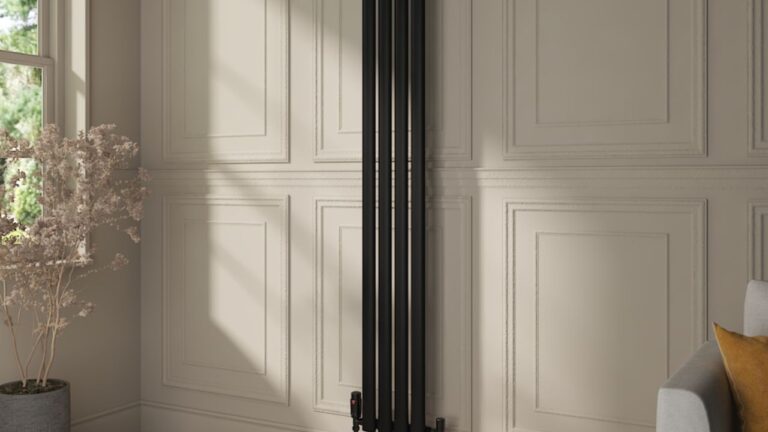
Renovating a period building is a bit like conducting an orchestra. You are trying to maintain the wonderful original features while introducing modern radiators which actually work for today’s living. And nowhere is this balance more important than with heating systems.
Let’s face it; those draughty Victorian townhouses and Georgian terraces look beautiful but were not built with central heating in mind. Still, in winter, we do like to curl up on our sofas without wearing three jumpers, don’t we?
The good news? You don’t have to choose between authenticity and warmth. Here’s how to get both.
Read your period property
Before you even think about radiators, take a long look around your home. What date is it from? What architectural features are important to you to keep?
In a little Eocene villa, for example, the roof will be gathered up like the court in a 16th-century maid. A Victorian house might have relatively high ceilings, some elaborate plaster cornices and certainly tall sash windows. An Edwardian property could show traces of Arts and Crafts influence with picture rails. Georgian homes frequently feature symmetry and graceful proportions.
Every period has its own character, and your heating should fit in with it rather than clash with it.
Why traditional radiators suit those period properties so well
Radiators were popular in period houses for a reason. They went with the building’s architecture at that time, and they still look quite at home today.
Column radiators go particularly well in rooms with high ceilings because they can be tall and skinny. They don’t swamp the space, but they do actually add to those vertical lines, which make period rooms feel so grand.
Plus, a traditional column radiator has such an honest, simple design. It’s not pretending to be what it isn’t. It’s functional, of course, but it is also part of the room’s character.
The Benefits of Column Radiators in Period Homes
- They are the right scale for architectural features.
- They can work with tall windows – the height is available.
- With their high heat outputs, these types of radiators are especially well-suited to large rooms that may be draughty and cold in winter.
- One of the main advantages of these radiators is that they can be situated directly under windows, allowing light to filter into your living space.
- This style of radiator draws the eye up, directing one’s gaze toward the room’s ceiling.
When Modern Radiators Actually Work Better
However, this is a field where things get complicated. There are times and occasions when a well-chosen modern radiator can outshine its period counterparts.
Consider your daily lifestyle. If you have installed contemporary fittings in these places, a new-style radiator is likely to fit right in. There is no harm in saying that this particular room has long outgrown its Victorian origins.
Modern flat panel radiators are a great alternative in hallways and smaller bedrooms. They take up less wall space but are just as effective and even more delicate than the traditional type of radiator.
What’s important is intention. You have to mean it when you choose deliberately to mix new and old. Contrast looks intentional instead of merely accidental.
Getting the Finish Right
This is easy to get wrong. You might pick the perfect kind of radiator for your house, but if then emulsion paint is slapped on it, it will just blend into the background.
A period house can take grand gestures. A deep grey or black radiator looks absolutely wonderful against white walls: column radiators become a real highlight.
Or, if you have a rich Heritage colour scheme on your walls, match the radiator to one of the tones that is a counterpoint in colour. Deep greens, purples, and navy blues are examples.
Popular finishes include
- Silvery or brushed stainless steel that looks utilitarian yet honest
- Black matte for drama
- Rich Heritage colours that match your paint scheme
- Smooth steel that turns into a patina with age
Make sure that you treat your radiators as part of the design scheme instead of thinking of them afterwards.
Location has a big impact on radiators in period rooms.
Through tradition, radiators are placed under windows (if possible, two under each one). The reason for this is simple. It reduces the cold air coming through the glass and reflects some again. In a building where beautiful windows are a major feature, however, you have to think hard about proportions.
A radiator that is too wide will not look right under a narrow window. One that’s too short under a tall window simply looks lost. To get these relationships correct, you need to plan a little, but it’s a task which pays dividends in terms of visual impact and mood: nobody wants their view spoiled by something as insignificant as a bad case of radiator technology.
Occasionally, an unconventional position is best of all. Radiators can also work beautifully on internal walls. especially heat loss through windows in habitable rooms. They become a vertical accent in themselves.
Trade-offs for Heat Output and Style
This is the one thing you have to be practical about. A delightful radiator that refuses to warm the room is never going to work for anybody.
Old houses often have more heat needs than modern ones because it’s harder to keep them warm. Those lovely thick walls and high ceilings with original lath and plasterwork instead of modern insulation are rather poor from an energy-arresting point of view, etc.
You may need to upsize your radiators to provide sufficient heat. This doesn’t mean going in for a single long panel at all. It means choosing radiators that have a good proportion of output to their size, or else fitting more radiators into larger spaces.
Column radiators are good in this respect because you can add extra columns without the radiator becoming deeper. It still stays slim but comes out with more power.
Mix it Up: Radiator Styles Throughout One Property
Here’s a secret: You don’t have to stick with the same radiator style in every room in your house.
Your room, ultimately, is as warm as your radiator. Traditional column radiators can be seamlessly integrated with the original aesthetic or paired with modern pieces to introduce an element of contrast. Be confident in the choice you make and be careful to carry out every aspect of having a clear purpose.
The good period renovation develops the feeling that we are bringing history into direct contact with the present. Your heating system can certainly be part of the dialogue; it brings warmth, convenience and style to spaces which have been bringing people home. Generation after generation, Heritage is intimately familiar with its citizens’ roots.
