

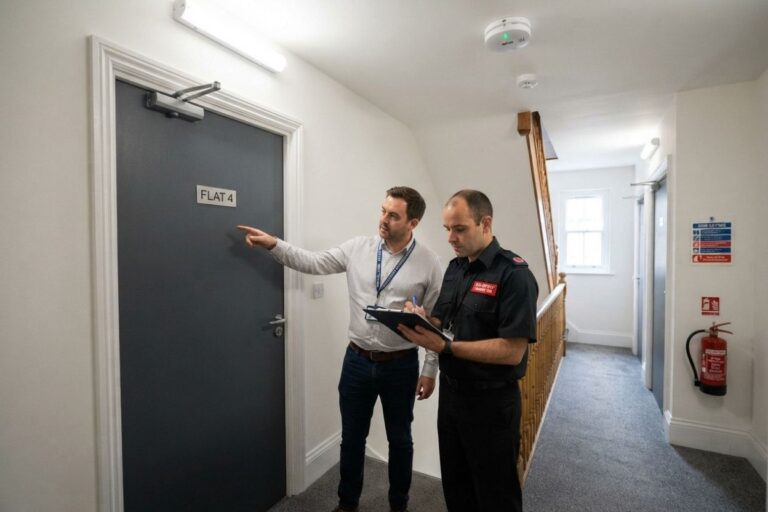
Converting a house into flats or letting it as a house in multiple occupation (HMO) can make good financial sense. Demand for rented rooms and smaller homes remains strong in many UK towns and cities, and older properties often lend themselves well to being split up.
What changes, though, is the level of fire risk. More people living independently under one roof means more cooking, more electrical appliances and more chances for something to go wrong. Property owners and landlords carry clear legal duties, so it pays to know what to check.
Why Conversions Carry Extra Risk
Many converted buildings were never designed to house several separate households. Floors and walls between flats may be timber with little fire resistance, stairs often form the only way out, and alterations made decades ago may not meet today’s expectations.
Some older conversions that do not meet the 1991 Building Regulations standards and have a mix of rented flats can themselves be classed as HMOs under section 257 of the Housing Act 2004. Local councils can assess fire risk in any rented home under the Housing Health and Safety Rating System, and they have powers to require improvements.
Start With a Proper Fire Risk Assessment
For the common parts of a converted building or HMO, a fire risk assessment is a legal requirement under the Regulatory Reform (Fire Safety) Order 2005. It should look at how a fire might start, how it could spread and how people would get out safely.
Many councils base their expectations on national guidance on fire safety in housing, which sets out typical measures for different property types. A competent assessor will apply that guidance to your building rather than relying on a generic checklist, and the assessment should be reviewed whenever the layout or occupancy changes.
Fire Doors and Compartmentation
In a converted building, the goal is usually to keep a fire contained within the room or flat where it starts while people escape along a protected route. That relies on walls, floors and doors that resist fire for a set period.
Doors onto the escape route are particularly important. In many HMOs and flat conversions, bedroom doors, flat entrance doors and kitchen doors are expected to be fire doors fitted with smoke seals and self-closers, although the exact specification depends on the risk assessment and any licence conditions. Some higher-risk areas, such as plant rooms or certain stair enclosures in larger buildings, may need a higher rating. If you are unsure which rating applies where, it helps to read up on the difference between FD30 and FD60 fire doors, including why a rated door only performs as tested when it is installed as a complete doorset.
Gaps around service pipes and cables also need proper fire stopping, as they can let smoke travel between floors.
Detection and Alarms
Early warning is essential when people are sleeping in different parts of a building. In England, the Smoke and Carbon Monoxide Alarm (Amendment) Regulations 2022 require landlords to fit at least one smoke alarm on each storey used as living accommodation and a carbon monoxide alarm in rooms with a fixed combustion appliance, other than a gas cooker.
HMOs and converted flats usually need more than this. Interlinked mains-powered detection, designed to BS 5839-6, is common, with heat detectors in kitchens and smoke detectors on escape routes. The grade and coverage should follow the fire risk assessment.
Keep Escape Routes Clear
A protected staircase is only useful if people can use it. Common problems in shared housing include:
- bikes, prams and rubbish stored in hallways
- fire doors wedged open for convenience
- locks that need a key to open from the inside
- failed lighting on stairs and landings
Regular inspections, clear house rules and emergency lighting where the assessment calls for it all help keep routes safe.
Licensing and Ongoing Checks
Larger HMOs, generally those occupied by five or more people forming two or more households, need a mandatory licence from the local council, and many councils run additional or selective licensing schemes too. Licence conditions often include specific fire safety requirements, so check them carefully.
Beyond licensing, landlords should arrange annual gas safety checks and electrical installation inspections at least every five years in privately rented homes, and keep records of fire alarm testing, door checks and maintenance.
Final Thoughts
Fire safety in converted flats and HMOs comes down to a few core principles. Understand the risks in your building, contain fire where it starts, warn people early and make sure they can get out quickly.
A thorough fire risk assessment, suitable fire doors, proper detection and clear escape routes go a long way. Keep on top of inspections and records, and you will protect both your tenants and your investment.
