

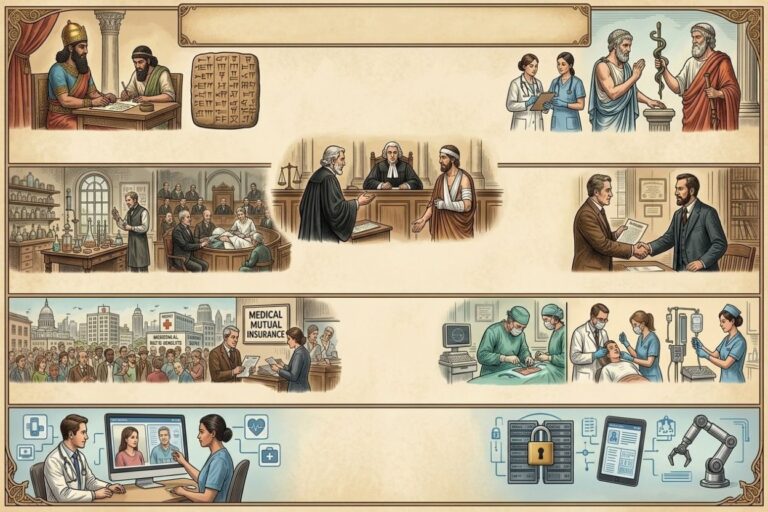
The idea that professionals can be held responsible for harmful mistakes is much older than the modern insurance industry. For centuries, societies have developed rules intended to establish responsibilities for people entrusted with specialized work, particularly physicians and other healthcare practitioners. What we now call medical malpractice gradually developed from broader legal concepts involving negligence, professional duty, and compensation for injuries.
Modern malpractice law is considerably more sophisticated than its early predecessors. Healthcare professionals today work within established licensing systems, professional standards, documentation requirements, and legal frameworks that did not exist in earlier periods. Malpractice insurance developed alongside these systems as healthcare became more complex and the financial consequences of professional liability claims increased.
Early Ideas About Responsibility in Medicine
Some of the earliest written legal systems addressed responsibility for medical treatment. The Code of Hammurabi, created in ancient Mesopotamia nearly 4,000 years ago, contained provisions dealing with physicians and the consequences of unsuccessful procedures. Those rules were dramatically different from today’s malpractice system, but they demonstrate that societies have long considered how healers should be held accountable for their work.
Ancient Greek medicine contributed another influential idea: physicians had ethical obligations to their patients. The tradition associated with the Hippocratic Oath emphasized professional conduct and responsibilities within medical practice. Ethics and malpractice law are not the same thing, but the development of professional expectations helped establish the broader idea that healthcare practitioners should follow standards when treating patients.
As legal systems developed in Europe, disputes involving professional services gradually became part of common-law traditions. Courts could consider whether someone with specialized skills had failed to exercise an appropriate degree of care.
The word “malpractice” itself came to describe improper or negligent professional conduct. Over time, it became particularly closely associated with medicine.
Malpractice Developed Alongside Modern Healthcare
Medical malpractice law became increasingly important as medicine changed during the 18th, 19th, and 20th centuries. Scientific advances gradually transformed healthcare, while professional education, hospitals, licensing systems, and medical organizations became more established.
As professional standards became clearer, courts had more information available when considering whether a healthcare professional’s actions were reasonable under particular circumstances.
In the United States, malpractice litigation became increasingly visible during the 19th century. Patients became more willing and able to pursue legal remedies when they believed professional treatment had caused an injury. At the same time, disagreements developed over what should qualify as negligence and how professional standards should be evaluated.
The modern concept of malpractice generally became connected to several fundamental questions. Did the professional owe a duty to the patient? Was the applicable standard of care breached? Did that breach cause an injury? Did the patient experience legally recognizable damages?
These questions remain important because a poor medical result alone does not necessarily establish malpractice. Healthcare cannot guarantee successful outcomes, and complications can occur despite appropriate treatment.
Professional Liability Insurance Became More Important
As malpractice claims became a larger financial concern, healthcare professionals increasingly looked for ways to protect themselves from the costs associated with defending claims and paying covered settlements or judgments.
Professional liability insurance became an important part of healthcare risk management.
Modern malpractice insurance can provide financial protection for certain allegations arising from professional services, subject to the policy’s terms. Coverage may include legal defense and covered damages, although limits, exclusions, deductibles, and other provisions vary.
The growth of medical specialties also made professional liability more complicated. Surgeons, physicians, nurses, dentists, therapists, and other healthcare professionals perform different tasks and encounter different risks. Insurance products consequently became more specialized.
Healthcare organizations also grew larger and more complex. Hospitals and medical groups needed coverage for organizational exposures in addition to the liability risks faced by individual professionals.
By the latter half of the 20th century, rising malpractice claims, premiums, and concerns about insurance availability periodically generated debates about what became known as medical malpractice “crises.” These debates contributed to changes in insurance markets and, in some states, legal reforms affecting malpractice litigation.
Dental Hygiene Malpractice Insurance Reflects Specialized Care
Dentistry experienced many of the same changes occurring throughout healthcare. Dental education became increasingly formalized, professional licensing expanded, and the responsibilities of dental team members became more clearly defined.
Dental hygienists eventually developed into a distinct licensed profession with important responsibilities for preventive and periodontal care, patient education, assessment, documentation, and other services permitted under state law.
As the profession expanded, individual liability became an important consideration. Today, dental hygiene malpractice insurance is a form of professional liability coverage designed to address certain claims related to a dental hygienist’s professional services, subject to the terms and limitations of the policy.
For example, a patient could allege that a hygienist caused an injury during treatment, failed to appropriately document or communicate an important observation, or otherwise acted negligently while providing professional services. Whether an incident actually constitutes malpractice depends on the circumstances and applicable legal standards.
Some hygienists may receive professional liability protection through their employers, while others may consider individual coverage. Because policies differ, professionals should understand who is insured, what activities are covered, what limits apply, and how coverage operates if they change employers.
Dental hygiene scope-of-practice rules also differ among states and can evolve. Hygienists should therefore remain familiar with current professional requirements in the jurisdictions where they practice.
Technology Has Created New Areas of Professional Risk
Malpractice has continued to evolve because healthcare itself continues to change.
Electronic health records have transformed documentation and communication. Telehealth allows professionals to interact with patients remotely. Digital imaging, artificial intelligence, automated systems, and increasingly sophisticated diagnostic technologies can influence clinical decisions.
These tools can improve efficiency and provide healthcare professionals with valuable information, but they can also introduce new questions about responsibility.
For example, electronic documentation can create a detailed record of patient care, but inaccurate copy-and-paste practices or incomplete records can potentially create problems. Telehealth can improve access to care, yet providers still need to determine whether a patient’s condition can be appropriately evaluated remotely.
Cybersecurity and privacy have also become significant concerns. A modern healthcare practice may need to consider not only professional liability insurance but also cyber insurance and other forms of business protection.
The fundamental principle behind malpractice, however, remains relatively familiar: professionals are expected to provide services according to applicable standards and can potentially face liability when negligent professional conduct causes harm.
Malpractice Law Continues to Change
Malpractice law is not a single nationwide set of rules. In the United States, many important aspects are governed at the state level, which means requirements and legal procedures can vary significantly.
States may have different statutes of limitation, procedural requirements, standards for expert testimony, rules concerning damages, and other provisions affecting malpractice claims.
Professional standards also evolve as healthcare changes. A practice that was commonly accepted decades ago may no longer reflect current clinical knowledge, technology, or professional expectations.
This makes continuing education and risk management important for healthcare professionals. Accurate documentation, clear communication, appropriate informed-consent practices, professional training, and adherence to applicable standards can all contribute to safer care.
Insurance must evolve as well. A professional who changes specialties, begins offering telehealth, moves to another state, or expands into new procedures may need to reconsider whether existing coverage still reflects the work being performed.
From Ancient Accountability to Modern Protection
The history of malpractice reflects a much broader history of professional responsibility. Ancient societies recognized that people providing medical treatment could cause harm, while later legal systems developed increasingly detailed ways to evaluate professional conduct and compensate injured patients.
As medicine and dentistry became more sophisticated, malpractice law became more structured. Licensing, professional education, clinical standards, expert testimony, and liability insurance all became parts of the modern system.
Today’s malpractice framework is far removed from the rules used thousands of years ago, yet the central question remains recognizable: what responsibility does a trained professional have when providing care to another person?
Modern malpractice insurance helps healthcare professionals manage some of the financial risks associated with that responsibility. At the same time, insurance is only one part of professional risk management. Education, communication, documentation, ethical conduct, and attention to evolving standards remain essential.
As healthcare continues to change, malpractice law and insurance will likely continue changing with it, just as they have throughout the history of professional medicine and dentistry.
