

The Complete 2026 Guide
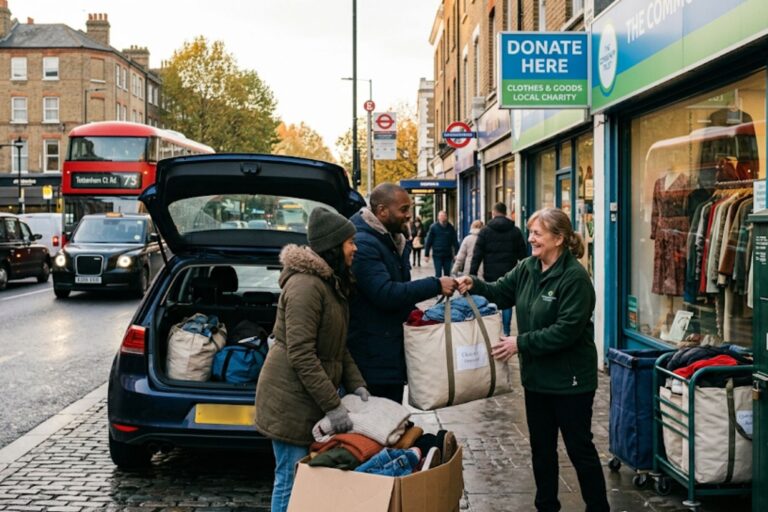
Wardrobes overflowing, charity shops full, and no car in sight. Here’s how London families are clearing out and giving back, without leaving the house. If you live in London, space is precious. Whether you’re renting a flat in Hackney, raising a family in Lewisham, or sharing a house in Ealing, the one thing London homes are almost never blessed with is storage. And yet the clothes keep piling up. The wardrobe bursting at the seams. The bin bags stashed under the bed. The children’s outgrown coats sitting in the corner since last winter, or the one before that. For millions of Londoners, unwanted clothing has become one of the most persistent, quietly stressful forms of household clutter. And it rarely solves itself. This guide covers everything you need to know about donating clothes to charity in London, including an option that doesn’t require a car, a trip to a charity shop, or even leaving your front door.
The Clutter Problem Hiding in London Homes
Think about the last time you had a proper clear-out. The jumpers from a phase that has passed. Shoes that pinched from day one but cost too much to throw away. Jeans that fit three years ago but don’t today. The jacket that was fashionable once but simply isn’t anymore. Most of these items are perfectly wearable. They’re not broken or dirty, they just no longer have a place in your life. But they’re taking up a great deal of space in your home. For families, the scale is even greater. A child can outgrow an entire wardrobe in a single year, leaving parents with bags of perfectly good kids’ clothes and nowhere to put them. Add seasonal items, replaced school uniforms, and the general accumulation of household life, and it becomes clear why so many London families feel perpetually overwhelmed by stuff.
The solution is to donate. But for Londoners, donating is rarely as simple as it sounds.
Why Charity Shops Can’t Always Help
For many people, the instinct is straightforward: sort the bags, load up the car, and drop everything at the nearest charity shop. The problem is that this assumes two things, that you have a car (a significant proportion of Londoners don’t), and that the charity shop is willing and able to accept your donations. UK charities do extraordinary work. They support people facing homelessness, bereavement, life-threatening illness, and social isolation. They provide communities with services that public funding can’t always reach. But to keep doing that work, they need money, and many rely heavily on their shops to generate income. Here’s the difficulty: many of those shops are full. Not slightly full, genuinely overwhelmed. Clothing donations have surged as people declutter, and many smaller charities cannot process, sort, store, and sell items at the rate they arrive. When a charity shop is at capacity, receiving more stock doesn’t help, it creates costs and logistical problems the charity can’t easily absorb.
The Doorstep Collection Alternative
This is the gap that free doorstep collection services have been created to fill. The model is built on a simple insight: removing the friction from donation makes everything work better, for the donor, for the charity, and for the people those charities serve. We Recycle Clothes, for example, has been ethically recycling clothes for over 15 years. They partner with a range of UK charities, organisations working with vulnerable animals, elderly people, children with life-threatening illness, those bereaved by suicide, people with complex neurological conditions, the homeless community, families affected by cancer, and those impacted by international conflict. The key difference from a traditional charity shop model is that donated items are collected, sorted, and resold through the company’s own network. The proceeds are then passed directly to the donor’s chosen charity, with a minimum of £200 per tonne of clothing donated and resold. Charities receive reliable income without the operational burden of processing stock they can’t handle.
How the process works
The process is refreshingly simple and completely free from start to finish. You book clothes donation online at werecycleclothes.org.uk, selecting your preferred charity, entering your address, and confirming your collection date. Then you bag up your donations using any clean bags you have. On collection day, you leave the bags on your doorstep. You don’t need to be home. The team collects everything free of charge, and your chosen charity receives the funds. This is particularly valuable for London families without a vehicle, for older residents who find it difficult to carry heavy bags, and for anyone whose nearest charity shop is either hard to reach or not currently accepting donations.
What You Can (and Can’t) Donate
Services like We Recycle Clothes accept a genuinely wide range of items, making them ideal for a comprehensive household clear-out. Here’s a quick breakdown of what’s typically accepted:
Men’s, women’s & children’s clothing, Paired shoes & boots, Handbags & rucksacks, Purses, wallets & belts, Hats, gloves & scarves, Watches & jewellery, Perfumes, Clean underwear & socks, Swimwear, Clean bed linen & towels, Curtains, Soft & plastic toys, Kitchenware, Small electronics (laptops, phones)
Items should be clean and in reasonable condition. Things that are generally not accepted include furniture, large electrical appliances, books, DVDs, pushchairs, duvets, pillows, rugs, and branded school uniforms. But for a typical household clear-out, the kind of decluttering that’s been on your to-do list for months, you’ll find that the vast majority of what you want to get rid of is happily accepted.
Why It All Matters
The volume of clothing in circulation across the UK is staggering. Millions of tonnes of textiles are discarded or left unused in homes every year. When clothes end up in landfill, they contribute to environmental damage that benefits no one. When they sit in bags in spare rooms, they clutter homes and weigh on the minds of families already dealing with the pressures of London life. But when unwanted clothes are donated through a well-organised collection service, they become something transformative. They become support for an animal looking for a home. They become funding for a support worker helping someone grieve. They become a service for families navigating a child’s life-threatening diagnosis. They become a meal, a bed, a conversation for someone sleeping rough in one of our cities. The connection between a bag of clothes left on a London doorstep and these outcomes might not feel obvious, but it’s real and direct.
Ready to Clear Out and Give Back?
A few bags. A quick online booking. A pile on your doorstep. Your home gets space, and a charity you care about gets funded.
BOOK A FREE COLLECTION NOW at www.werecycleclothes.org.uk
