

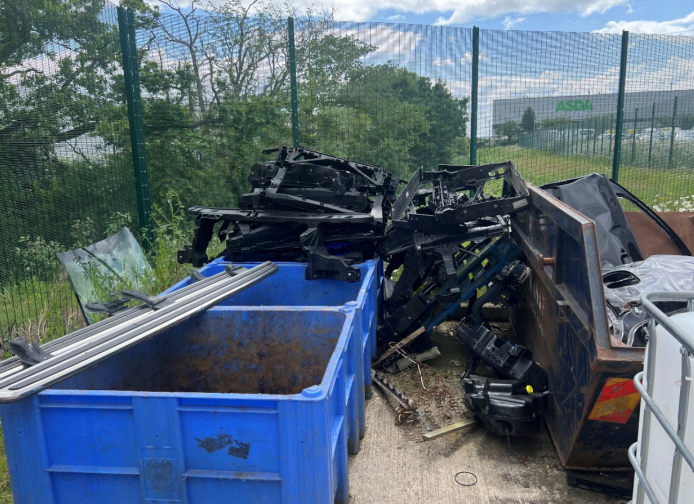
| Bodyshops build a compliant hard plastic waste management routine by identifying polymer types (PP, ABS, TPO), segregating each into separate labelled cages, preventing chemical and metal contamination, storing waste on impermeable surfaces, and issuing Waste Transfer Notes using EWC code 16 01 19. Every collection must be handled by an Environment Agency-registered carrier. This satisfies UK Duty of Care obligations under the Environmental Protection Act 1990 and supports End-of-Life Vehicle Regulations recovery targets. |
Why Most UK Bodyshops Have a Plastic Waste Compliance Gap – And How to Close It
There is a compliance gap running through most UK bodyshops, and it is not about paint, solvents, or oils. It is about plastic – specifically, the hard plastic bumpers, trims, and panels that come off vehicles every single working day.
According to the Environment Agency’s Chief Regulator’s Report, over 90% of all enforcement notices issued in 2024 were directed at the waste sector. Of those, 55% of the most serious permit breaches came down to poor management – inadequate storage, careless handling, and the complete absence of any organised compliance process.
These are bodyshop problems. And since December 2023, when the UK Government removed the previous £250,000 cap on Variable Monetary Penalties, the financial exposure from getting this wrong has no ceiling.
But there is a better way to look at this. The car bumper recycling UK opportunity is real. Clean, segregated polypropylene from automotive bumpers has genuine market value. Workshops that build a documented routine do not just avoid fines – they reduce costs, attract fleet clients, and strengthen their position in insurance-approved repairer networks. Specialist automotive waste management providers such as Auto Body Collections have built their entire service model around making this process straightforward for UK bodyshops, with scheduled collections and full compliance documentation on every visit.
This guide builds the routine from the ground up – step by step, without jargon.
What Counts as Hard Plastic Waste in a UK Bodyshop?
Hard plastic waste in a bodyshop refers to rigid polymer components removed during vehicle repair or replacement. It does not include foam padding, rubber seals, or soft-touch coatings, which follow separate waste routes.
The most common hard plastic parts a bodyshop generates include:
- Front and rear bumper assemblies – predominantly PP or TPO, typically 2.5 to 4 kg each.
- Mirror housings – generally ABS, 0.3 to 0.8 kg.
- Wheel arch liners – PP, 0.5 to 1.2 kg.
- Grille assemblies – ABS or PC/ABS blend, 0.4 to 1.0 kg.
- Headlight and tail light housings – polycarbonate lens with ABS housing.
- Interior dashboard and trim panels – ABS or PC/ABS blend; weight varies by vehicle.
Modern vehicles contain up to 39 different polymer types. Polypropylene alone accounts for approximately 37% of all vehicle plastic by weight, which explains why bumpers form the largest and most consistent hard plastic waste stream in most bodyshops.
Under UK law, the moment any of these components are removed from a vehicle during repair, they become controlled waste. Your legal obligations begin at that point.
The Legal Reality Every UK Bodyshop Needs to Understand
UK bodyshop plastic waste compliance is built on three pieces of legislation that work together.
1. The Environmental Protection Act 1990
Section 34 establishes the Duty of Care – the foundational legal obligation covering every business that produces, stores, or disposes of waste. This duty runs from the moment waste is generated to its final legal destination. If the chain breaks at any point, the liability can trace back to the original producer.
2. The Waste (England and Wales) Regulations 2011
These regulations define the requirement for registered waste carriers and set out exactly how Waste Transfer Notes must be completed. Incomplete or vaguely described Transfer Notes constitute a compliance breach on their own, independent of how the waste itself was handled.
3. The End-of-Life Vehicles Regulations 2003
Retained in UK law post-Brexit, these regulations require that 95% of a vehicle by weight is reusable or recoverable, with at least 85% going to genuine material recycling. These targets apply to parts removed during repair, not just end-of-life scrapping – which means the plastic your bodyshop generates carries a documented recovery obligation attached to it.
The UK’s Packaging Extended Producer Responsibility (pEPR) scheme, which became fully active under the Producer Responsibility Obligations (Packaging and Packaging Waste) Regulations 2024 and commenced fee collection in April 2025, is also expanding obligations for businesses handling qualifying packaging volumes. Bodyshops should verify their specific position against the relevant thresholds on GOV.UK.
Step 1 – Identify Your Plastics Before Anything Goes in a Cage
This is the step most compliance guides skip, and it is the one most likely to cause practical problems.
Sending mixed PP and ABS to a reprocessor does not result in a partial recovery. It results in the entire load being rejected and rerouted to landfill. The disposal cost and the documentation gap land back with the bodyshop that produced the waste.
Polymer identification does not require chemistry knowledge. Most automotive plastic components carry a stamped resin identification code on the inside or rear face of the part, inside a recycling triangle.
| Stamp | Polymer Full Name | Common Bodyshop Parts | Feel / Appearance |
| >PP< | Polypropylene | Bumpers, arch liners, battery trays | Slightly flexible, waxy surface |
| >ABS< | Acrylonitrile Butadiene Styrene | Mirror caps, grilles, interior trims | Rigid, matte or gloss, brittle crack |
| >TPO< | Thermoplastic Olefin | Soft bumper skins on modern vehicles | Soft-touch finish, no flex memory |
| >PC/ABS< | Polycarbonate / ABS Blend | Dashboard bezels, cluster housings | Heavy, high-gloss finish |
| >PC< | Polycarbonate | Headlight lenses, sunroof panels | Very hard, transparent or tinted |
No Visible Stamp? Use This Three-Step Floor Check:
- Flex the part. PP flexes without breaking. ABS snaps cleanly. PC does neither.
- Check the surface finish. TPO has a soft, rubber-like touch. ABS and PC/ABS are harder and glossier.
- Still uncertain? Place the part in a separate cage labelled “unidentified hard plastic.” Your carrier’s materials recovery facility can sort it.
Practical tip: Print the polymer table above, laminate it, and fix one copy to each cage. It takes ten minutes to set up and prevents expensive load rejections.
Step 2 – Build Your Segregation System for Automotive Hard Plastic Waste
Once technicians can identify polymer types, the physical setup is straightforward. Each polymer stream needs its own dedicated labelled cage or stillage, positioned within three metres of the main strip bay. Distance is the enemy – cages placed in a far corner of the yard will be ignored under time pressure.
Recommended Cage Colour-Coding and Layout:
| Cage | Label Colour | Polymer Stream | Typical Parts |
| A | Green | PP only | Front and rear bumpers, wheel arch liners |
| B | Blue | ABS and PC/ABS | Interior trims, mirror caps, grilles |
| C | Yellow | TPO | Soft-touch bumper skins, modern fascias |
| D | Red | Contaminated or unidentified | General waste only – not for recycling |
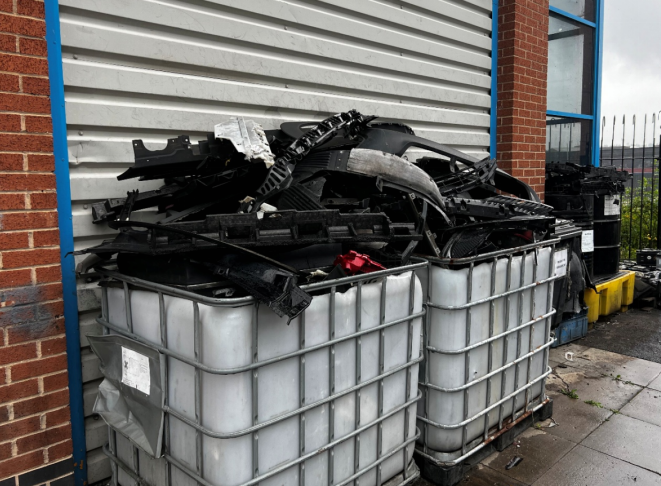
Before Any Part Goes into a Cage, the Technician Must:
- Remove all metal brackets, bolts, and number plate mounts.
- Peel any foam or rubber backing from the rear face of bumpers.
- Pull out wiring clips and harness attachments.
- Check the inside face for the resin stamp and confirm the polymer type.
Set a physical fill-line marker – a cable tie fixed at 75% of the cage height works well. When the cage reaches that level, trigger a collection request regardless of your regular schedule. This prevents cage overflow and the loose plastic on site that comes with it.
Bodyshops looking to streamline the full process can arrange a scheduled automotive hard plastic collection through a specialist registered carrier, with cage swap-outs built into the schedule and Waste Transfer Notes issued automatically on every visit.
Step 3 – Contamination Control: What Ruins a Car Bumper Recycling Batch
Contamination is the most common reason automotive plastic loads are rejected at the reprocessor. A single problem part can cause an entire cage load to be rerouted to landfill.
The Most Common Contamination Errors in UK Bodyshops:
- Oil or fuel residue on parts from engine bay damage. These reclassify as hazardous waste under the UK Waste Framework Directive and require a different carrier, different documentation, and higher disposal costs.
- Heavy paint saturation. Parts where more than 50% of the surface area is deeply paint-saturated should go to general waste, not the plastic cage.
- Attached metal fixings. Any bracket, bolt, or clip not removed before caging will contaminate the entire polymer batch.
- Mixed polymers in the same cage. PP and ABS in the same container means neither stream can be cleanly reprocessed.
- Coolant or washer fluid still held in removed parts. Drain and wipe before placing into any cage.
Quick Contamination Decision Check – Under 60 Seconds Per Part:
- Are all metal fixings removed? – If not: strip first before caging.
- Is the surface more than 50% free of oil, fuel, or chemical residue? – If not: general waste.
- Is the polymer type confirmed? – If not: unidentified cage.
- All three clear? – Place into the correct polymer cage.
Running this check takes under 60 seconds per part when it is built into normal stripping practice. It prevents rejected loads and the additional disposal costs and paperwork breaches that come with them.
Step 4 – Legal On-Site Storage: What Environment Agency Inspectors Actually Check
Hard plastic waste must be stored correctly on your premises from the moment it is generated. The following requirements are legal obligations under UK waste regulations, not recommendations.
- Storage surface: Cages must sit on an impermeable, sealed surface – sealed concrete or an epoxy-coated floor. Loose tarmac, gravel, and bare earth do not qualify. If your cages sit on a non-compliant surface, bunding (a secondary containment barrier) around the base is required.
- Windproof containment: Cages must be enclosed and windproof. Loose plastic fragments leaving the site constitute a littering offence under the Environmental Protection Act 1990. Wire mesh cages with a secured lid or fixed wind netting meet this requirement.
- Drain separation: Keep cages at least 10 metres from drainage points where practical. Small plastic particles entering surface drainage can trigger a separate controlled waste offence.
- Site registration: If your site stores more than a small volume of hard plastic at any time, you may need a T11 exemption registered with the Environment Agency. This covers non-hazardous waste storage up to 60 tonnes at any one time and is free to register online.
What an Environment Agency Inspector Checks on Arrival:
- Waste stored away from drains and watercourses.
- Site registered with the correct exemption or permit.
- Cages labelled with waste type and EWC code.
- Waste Transfer Notes available on site for recent collections.
- Carrier licence copies held on file.
Step 5 – Waste Transfer Notes and EWC Codes: The Documentation Every Collection Requires
Every collection of hard plastic waste from your site requires a completed and signed Waste Transfer Note. This is a legal document under the Environmental Protection Act 1990.
A Valid Waste Transfer Note Must Include:
- Date and time of the transfer.
- A specific waste description – see the guidance note below.
- EWC code 16 01 19 – the correct code for plastics arising from vehicle maintenance and dismantling.
- An estimated quantity in weight or volume.
- Your business name and address as the waste producer.
- The carrier’s name, address, and EA registration number.
- Signatures from both parties at the point of collection.
| Waste Description GuidanceCorrect: “Automotive bumper assemblies and hard trim panels, predominantly PP, uncontaminated, approximately [X] kg.”Incorrect: “Mixed plastics.” – This is too vague. The Environment Agency can treat it as insufficient Duty of Care documentation and issue a breach notice. |
Never use EWC code 07 02 13. That code applies to plastics from chemical and polymer manufacturing. Using the wrong code on a Transfer Note is a Duty of Care breach even if the waste was physically disposed of correctly.
Retain all signed Waste Transfer Notes for a minimum of two years. A three-year retention policy is recommended, as Environment Agency audit cycles commonly cover a three-year window. A simple A4 binder, tabbed by month, is sufficient. The Environment Agency publishes a free Waste Transfer Note template on GOV.UK.
Step 6 – How to Choose and Vet a Registered Waste Carrier in the UK
Using an unregistered carrier – even unknowingly – places joint liability for any illegal disposal of your waste on your business. The Duty of Care does not allow ‘I didn’t know’ as a defence.
How to Verify a Carrier’s EA Registration in Under Two Minutes:
- Go to environment.data.gov.uk/public-register (the Environment Agency Public Register).
- Enter the carrier’s company name or registration number.
- Confirm the status shows “Active” with a current expiry date.
- Save or print a PDF of the result. File it with the carrier’s contract.
Red Flags That Should Stop You Using a Collector:
- Cash-only collection with no paperwork offered.
- Unable to produce an EA registration number on request.
- Arrives in an unmarked or non-commercial vehicle.
- Refuses to sign a Transfer Note or issues an incomplete one.
- Quotes significantly below the standard market rate for collection.
When speaking with a carrier for the first time, ask where your automotive hard plastic goes – whether to a materials recovery facility (MRF) or directly to a specialist reprocessor. Ask whether they can combine plastic collection with scrap metal and waste oil in the same visit. Many specialist automotive waste carriers operate combined routes, which reduces your per-collection cost and consolidates your Transfer Note admin into a single event.
Step 7 – Running the Routine and the Business Case for Car Bumper Recycling UK
Recommended Collection Frequency by Workshop Throughput:
| Monthly Bumper Volume | Recommended Collection Frequency |
| Fewer than 20 bumpers | Monthly or on-demand |
| 20 to 50 bumpers | Bi-weekly |
| More than 50 bumpers | Weekly standing order |
Building the Staff Habit – Not Just the Policy:
- Show: Demonstrate polymer identification and cage placement in the actual strip bay, not in a meeting room or on paper.
- Supervised practice: Watch the technician sort three or four real parts with live correction.
- Independent with spot check: From week two onward, run a two-minute random cage check once a week.
Assign one named technician – not a manager – as the workshop’s Waste Champion. Their responsibility is the weekly cage check: correct segregation, no visible contamination, labels still readable, fill level below the 75% trigger mark. Peer accountability in a workshop environment works consistently better than top-down enforcement.
The Financial Case for Getting This Right:
Clean, segregated PP from bumpers can attract payments from specialist reprocessors, typically ranging from £20 to £80 per tonne depending on grade and current commodity pricing. A busy bodyshop removing 15 to 20 bumpers a week can accumulate close to one tonne of PP per month.
Meanwhile, a single Environment Agency enforcement notice for a Duty of Care breach starts at £300 for a fixed penalty and now carries no upper limit for civil sanctions. The total cost of building a compliant routine – cages, a binder, and 30 minutes of staff time – is a fraction of one enforcement event.
Bodyshops with documented car bumper recycling UK records are also increasingly competitive for fleet and insurance-approved repairer contracts, where sustainability credentials are now a standard assessment criterion across most major insurance networks.
Seven Compliance Mistakes UK Bodyshops Must Avoid
- Using EWC code 07 02 13 instead of 16 01 19. The Transfer Note is non-compliant even if the plastic was handled correctly.
- Describing waste as “mixed plastics.” The EA requires a specific description covering the main components of the load.
- Storing cages on gravel or bare earth. This does not constitute an impermeable surface. Move to sealed concrete or install bunding.
- Using an unverified collector. Always confirm Active status on the EA Public Register before the first collection.
- Placing oil-soaked or chemically contaminated parts in the plastic cage. These require hazardous waste treatment and separate documentation.
- Keeping Transfer Notes for only one year. The legal minimum is two years. Three years is strongly recommended.
- Positioning cages more than three metres from the strip bay. Distance leads to skipped sorting and cage contamination under production pressure.
Frequently Asked Questions
Can you recycle car bumpers in the UK?
Yes. Plastic car bumpers are fully recyclable in the UK through specialist automotive waste carriers and reprocessors. Under the Environmental Protection Act 1990, bodyshops are legally required to ensure bumpers are collected by a registered carrier and that a signed Waste Transfer Note is issued at every collection.
What type of plastic are car bumpers made of?
Most car bumpers are made from Polypropylene (PP) or Thermoplastic Olefin (TPO). The resin type is stamped on the inner face of the bumper – look for >PP< or >TPO< inside the recycling triangle. PP is the most widely recycled automotive plastic in the UK and has well-established domestic reprocessing routes.
What is the correct EWC code for plastic car bumpers?
The correct EWC code is 16 01 19 – plastics arising from vehicle maintenance and dismantling. Using code 07 02 13 (which applies to plastics from chemical manufacturing) is a documented Duty of Care breach, even when the plastic itself is correctly disposed of.
Who collects car bumpers for recycling in the UK?
Environment Agency-registered waste carriers who specialise in automotive waste handle bumper collections for UK bodyshops. These carriers provide signed Waste Transfer Notes at the point of collection and transport material to certified reprocessors. Registration status can be verified on the EA’s free online Public Register in under two minutes.
Do bodyshops legally have to keep Waste Transfer Notes?
Yes. UK Duty of Care regulations require Waste Transfer Notes for non-hazardous waste to be retained for a minimum of two years. Three years is the recommended retention period. Failure to produce Transfer Notes on request from the Environment Agency is itself a breach, independent of how the waste was disposed of.
Is car bumper recycling profitable for UK bodyshops?
Clean, segregated PP from bumpers has genuine commercial value with specialist reprocessors – typically £20 to £80 per tonne. A bodyshop removing 15 to 20 bumpers a week can generate close to one tonne of PP per month. Combined with reduced disposal costs and consolidated collection scheduling, a documented routine generates a measurable return over time.
Build the Routine Once – Then Let It Run
The bodyshops handling this well are not spending more time on waste management. They have embedded the process into the strip bay workflow – identify the polymer, strip the fixings, cage by type, log the collection, file the note. Five steps, built into what already happens every working day.
With EA enforcement pressure on the automotive sector increasing and no upper limit on financial penalties, the gap between having a documented routine and not having one carries real commercial consequences. The car bumper recycling UK opportunity is not just about compliance – it is about running a workshop that wins fleet work, passes sustainability audits, and keeps every waste collection properly on record.
