

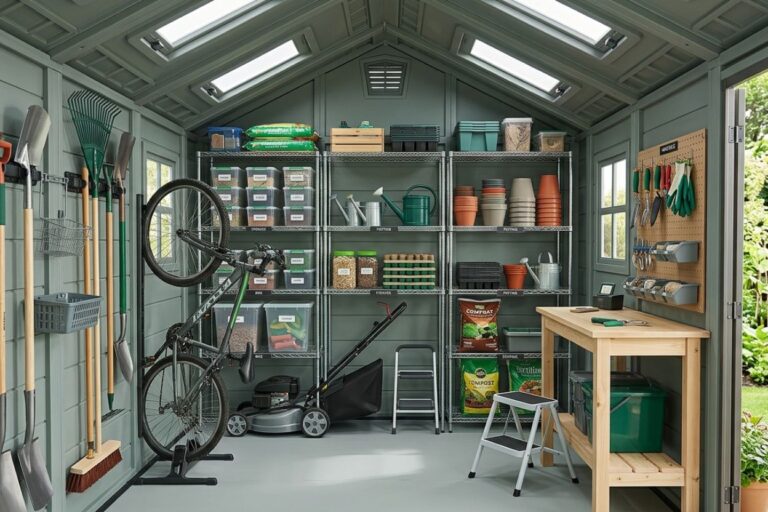
A plastic shed in its default state — four walls, a roof, a door, and an empty floor — is a significant improvement on no shed, but it is not yet a well-used space. The difference between a shed that works and one that merely exists is almost entirely down to what happens after it is built: how the space is organised, what is stored where, and whether the internal layout has been thought through to support the way you actually use the garden rather than assembled based on what happens to fit.
The good news is that plastic sheds respond extremely well to organisation. The walls are typically smooth, flat, and regular, which makes them easier to work with for shelving and hooks than the variable surfaces of an older timber building. Many modern plastic garden buildings include shelving provisions built into the design, and a well-stocked accessory market has grown up around the category with products designed specifically for plastic shed interiors. Getting organised does not require a complete refit or a large additional budget — it requires a plan and an afternoon.
Empty It First
The single non-negotiable starting point for organising any shed, plastic or otherwise, is a complete empty-out. Everything comes out, is assessed, and either goes back in with a specific designated place or does not go back in at all. This sounds obvious and is consistently skipped, which is why so many shed organisation projects fail to produce lasting results: you cannot design an organisation system around the things that are already in the shed, because those things include too many items that should not be there.
The clear-out serves several functions simultaneously. It reveals the actual volume and variety of what needs to be stored, which is the essential information for planning the internal layout. It identifies things that need replacing (the rusted trowel, the cracked hose connector, the bag of compost that has been open since last spring), removing (the broken flowerpots, the empty paint tins, the tools whose function you cannot now recall), or relocating (items that ended up in the shed but properly belong elsewhere). And it gives you a clean, empty space to work from, which makes the subsequent organisation feel like a genuine fresh start rather than a reorganisation of clutter.
The Zone System
Dividing the shed into functional zones — areas designated for specific categories of item rather than general storage — is the most consistently effective approach to shed organisation, and it works in a plastic shed just as well as in any other type. The principle is that everything has a designated home, and that home is chosen to suit both the item and your workflow.
The zone nearest the door should contain the things you reach for most often: the trowel, the secateurs, the gloves, the string, the hand fork. These items should be at a comfortable working height and immediately accessible without moving anything else. The further from the door, the less frequently accessed: seasonal equipment, overflow compost bags, the barbecue cover, Christmas lights, things that come out twice a year and can reasonably be retrieved with a little more effort.
Heavy items — bags of compost, the lawnmower, the wheelbarrow — belong on the floor near the door, where getting them in and out involves minimal manoeuvring. Lightweight items — seed packets, plant labels, small bottles of feed and treatment products — can go higher up, on shelves or in wall-mounted containers, where they take up floor space only in the vertical dimension.
Getting the Walls Working
The walls of a plastic shed are its most underused resource. Most shed owners treat the floor as the primary storage surface and regard the walls as structural rather than functional — which is precisely backwards, because floor storage is the least efficient arrangement in a confined space. Everything on the floor is inaccessible until the things in front of it are moved. Everything on the wall is visible and reachable at a glance.
For plastic shed walls, freestanding shelving units that sit against the wall are often more practical than direct wall-mounted shelving, which requires drilling or screwing into plastic panels of variable thickness. A freestanding metal shelving unit — the same kind used in garages and utility rooms — can be positioned against the back wall, loaded with pots, bottles, and smaller items, and relocated or removed without any impact on the shed itself. This flexibility suits plastic buildings particularly well.
Hooks and hanging systems designed for plastic shed walls are available from most garden centres and online retailers. Over-door organisers — the kind that hang from the top of the door — are especially useful for hand tools, gloves, and the small items that tend to end up loose at the bottom of a pile because there was no obvious place to put them. A good selection of garden storage organization ideas is useful when thinking through the internal layout before you commit to buying accessories.
Shelving: Getting the Details Right
If you install fixed or freestanding shelving inside a plastic shed, a few specifics make a significant difference to how well it works in practice. Shelf depth should be modest — 200 to 250mm is usually sufficient, and deeper shelves tend to swallow items that are never seen again. Shelf height should be calibrated to the actual items you will store on each level before anything is fixed in place. A shelf set two centimetres too low for your tallest spray bottles means those bottles live on the floor; a shelf set at the right height means they live on the shelf and the floor stays clear.
Materials matter for a shed environment. Wire shelving allows air to circulate around stored items, which matters for things like seed potatoes and bulbs. Solid timber shelving provides a better work surface and handles heavy loads more reliably. Plastic shelving units are the easiest to clean and immune to the damp conditions that can develop in any shed through a British winter, but the cheaper versions are not always as rigid as the situation demands.
Accessories Worth Having
A handful of relatively inexpensive accessories make a disproportionate difference to how well a plastic shed functions as a working space. A small step stool or folding step gives access to high shelves without the awkward reaching that leads to things being left on lower surfaces out of convenience. A magnetic strip — the kind sold for kitchen knives — mounted at a convenient height provides instant accessible storage for hand tools with metal components. A simple hook system on the inside of the door makes use of the door space that most people treat as dead area.
For sheds being used to store bikes or larger wheeled equipment, floor-track systems that hold bikes vertically against the wall free up an enormous amount of floor space relative to bikes stored flat. These are available for plastic shed floors and represent one of the most significant single improvements available to a bike-storing household.
Starting With the Right Building
The best shed organisation begins with choosing a building that is suited to your storage needs in terms of size and layout. A shed that is genuinely too small for its intended contents cannot be organised into adequacy; one that is right-sized from the start is a much more rewarding project. For anyone at the buying stage, the plastic shed range at Dobbies covers a good spread of sizes and internal layouts, and it is worth checking the internal dimensions carefully before purchasing — particularly the wall height at the eaves, which varies across designs and affects how much of the vertical space is practically usable for shelving and wall storage.
